
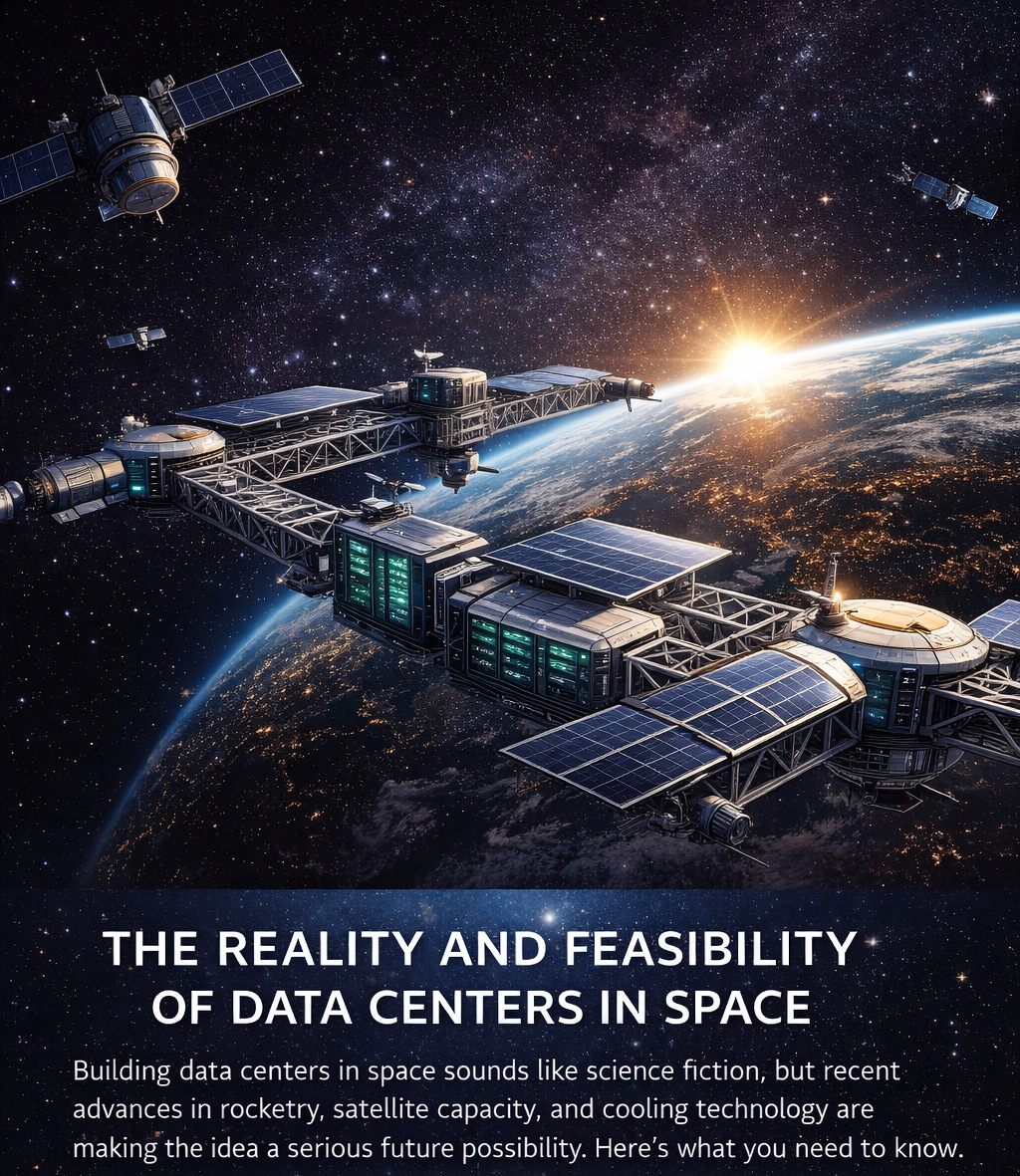
Putting a data center in space sounds like the sort of idea that lives somewhere between a pitch deck and a science-fiction trailer. But the question is not ridiculous. If launch keeps getting cheaper, if power systems become more efficient, and if more of the world's most valuable data is generated in orbit, then “data centers in space” stops being a joke and becomes an infrastructure question.
The catch is that space does not remove the hard parts of computing. It rearranges them. A terrestrial data center worries about land, water, grid access, cooling, regulation, and proximity to customers. An orbital data center would worry about launch mass, thermal rejection, radiation, servicing, communications latency, and whether the whole thing can compete with facilities that already work very well on Earth.
The question is not whether space can host computing. It is whether it can host computing efficiently enough to justify the launch and maintenance bill.ISN editorial shorthand for orbital computing
What people mean by a data center in space
Most people are not imagining a giant cloud region in low Earth orbit serving ordinary web traffic. They are usually talking about one of three things.
First is edge computing in orbit: processing satellite imagery, sensor data, or defense payload output before sending only the useful results to Earth. Second is compute attached to space networks, where the processing stack lives near communications or remote-sensing hardware. Third is the more ambitious idea of large orbital server farms powered by solar energy and connected to the ground through high-capacity radio or optical links.
Those are very different business cases. The first is already credible. The second is plausible in specific mission architectures. The third is the one that gets the headlines and the one most likely to fail if it is treated like a terrestrial data center in zero gravity.
The hardest problem is heat
On Earth, data centers dump heat into the air, water, and chilled infrastructure around them. In space, there is no atmosphere to carry heat away by convection. That means excess heat has to be rejected mostly through radiators.
This is where casual versions of the idea become too optimistic. Servers generate heat. High-performance compute generates a lot of heat. In orbit, every watt you use becomes a thermal management problem. If you scale the compute up, you also scale radiator area, power conditioning, structure, and failure points.
That does not make orbital computing impossible. It does mean thermal control is not a side issue. It is the design driver.
Space-based data centers are physically possible, but they are not a shortcut around Earth's infrastructure problems. They only make sense if they do something in orbit that is expensive, slow, or strategically awkward to do from the ground.
Launch mass and servicing decide the economics
Even if the physics works, the business case still has to survive launch and maintenance reality. Data centers on Earth are upgraded constantly. Servers are replaced. Storage changes. Cooling systems get tuned. Failed components can be swapped in hours.
In orbit, every kilogram has to be launched. Every repair is harder. Every spare part is a payload decision. That means a space-based data center would need one of two things: very high margins for a specialized mission, or a dramatic drop in launch and servicing costs.
This is why launch cadence, reusability, and on-orbit servicing matter so much. A future with cheaper heavy lift, more standardized spacecraft, and more routine orbital repair changes the answer. A future without those things keeps orbital computing niche.
The logic is similar to what ISN explored in The Netscape Moment for Space: once space systems become operational infrastructure, the key question shifts from “can it fly?” to “can it be sustained, serviced, and justified over time?”
Latency is narrower than the hype
One common pitch is that an orbital data center would somehow make computing faster for everyone. That is not generally true. For many workloads, terrestrial data centers already sit close to major population centers and fiber routes. Sending ordinary consumer or enterprise traffic up to space and back often adds complexity rather than removing it.
The stronger case is narrower. A data center in space makes more sense when the data already starts in space. If a remote-sensing satellite can process imagery onboard, identify relevant changes, compress the result, and send down only what matters, that can save bandwidth and speed decisions. The same logic can apply to weather, navigation, missile warning, intelligence, or communications payload management.
In other words, the strongest case is not “replace cloud computing on Earth.” It is “perform selected compute tasks in orbit because that is where the data or mission already lives.”
Security and resilience cut both ways
There is a serious national security and resilience argument for distributed orbital infrastructure. A space-based compute layer could reduce dependence on vulnerable terrestrial links in some scenarios, support defense space operations, and create redundancy for critical systems.
But orbit is not a safe haven. It is an exposed operating environment. Spacecraft face radiation, debris, electronic warfare risk, cyber risk, line-of-sight constraints, and increasingly contested orbital conditions. A data center in space is not hidden. It is a strategic asset that would need protection, redundancy, and hardening.
That makes the concept more relevant to national security space and satellite operations than to generic cloud hype. The question is not whether orbit is “better.” The question is whether orbit is worth the complexity for a specific mission set.
What would have to change
For orbital compute to scale beyond niche workloads, a few things have to move at once. Launch has to stay cheaper. Power generation has to become more efficient. Thermal rejection has to become less bulky. Servicing has to become routine. And operators have to prove that the workload really belongs in orbit.
If those ingredients line up, the near-term future is still not a giant orbital cloud region replacing terrestrial hyperscalers. It is more likely to look like hosted compute modules, edge processing for Earth-observation constellations, onboard AI acceleration for satellite networks, and tightly scoped mission computing for space infrastructure.
That path matches how space systems usually mature: first come targeted mission tools, then standard platforms, then larger infrastructure layers if the economics improve.
The real test is the mission
It is easy to ask whether a data center can be built in space. The harder and more useful question is this: what job does it do better there than on Earth?
If the answer is vague, the concept stays speculative. If the answer is concrete — lower downlink demand, faster in-orbit decision-making, closer integration with satellite constellations, mission resilience, or defense-space utility — then the idea becomes much more serious.
So the reality and feasibility of data centers in space should be discussed as an infrastructure problem, not a fantasy. The physics allows it. The economics limit it. The operational case will decide it.
This article targets: data centers in space, orbital compute, space data center economics, thermal management in space, launch economics, edge computing in orbit, satellite infrastructure, space industry, orbital servicing, and latency in space communications.