
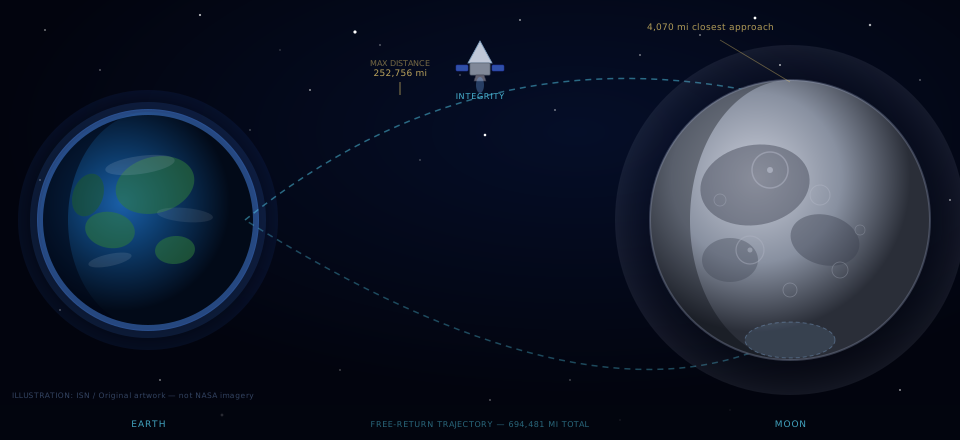
A few minutes past five o'clock Pacific time on April 10, 2026, a heat shield scorched by 3,000-degree reentry plasma broke the surface of the Pacific Ocean off San Diego. Inside the Orion crew module named Integrity sat four astronauts who had done something no human had done in 54 years: flown beyond the confines of low Earth orbit and returned. Commander Reid Wiseman. Pilot Victor Glover. Mission Specialists Christina Koch and Jeremy Hansen of the Canadian Space Agency. They had traveled 252,756 miles from their home planet, seen the lunar far side in real time, and broken the distance record set by Apollo 13 in 1970 — this time, on purpose.
The Artemis II mission was technically a shakedown cruise: a systematic evaluation of life support systems, navigation, propulsion, and deep-space communication under real operational conditions. But to describe it only in those terms is to miss the larger point. What happened over ten days in April 2026 was an inflection point for NASA, for the United States, for the international community of spacefaring nations, and for every investor, entrepreneur, and institution that has made a bet on the emerging lunar economy.
We choose this moment to challenge this generation and the next to make sure this record is not long-lived.CSA Astronaut Jeremy Hansen, upon setting the human distance record
What Artemis II Actually Accomplished
Strip away the symbolism and the technical achievements are substantial. Artemis II validated Orion's life support systems in the actual radiation and thermal environment of deep space — something no amount of ground testing can replicate. The crew conducted manual piloting demonstrations, tested the spacecraft's handling characteristics in cislunar space, and supported science investigations aboard, including studies of how radiation and microgravity affect human health at the cellular level.
The mission also exercised ground systems, communication protocols, and the recovery infrastructure that NASA and the Navy depend on to bring crews home safely. Those procedures are the invisible infrastructure on which Artemis III and IV will depend. The lunar south pole landing planned for Artemis IV in 2028 is only credible because Artemis II worked.
And in one indelible moment, as Orion passed behind the Moon and the crew lost all contact with Earth for 40 unmediated minutes, they observed what Victor Glover described as an unreal view of the Moon in the foreground and stars beyond. Christina Koch looked back at the crescent of Earth and said, "In the end, we will always choose the Earth, and we will always choose each other." NASA's livestream peaked at millions of viewers. For a brief span, the most-watched content in the world was four humans going around the Moon.
The Programme's Uncertain Path Forward
Artemis II's success lands in a programme environment that is, frankly, in flux. The Lunar Gateway — the planned orbital space station that was to serve as a staging point for lunar surface operations — was cancelled in March 2026, just weeks before launch. The human landing mission was pushed from Artemis III to Artemis IV. Artemis III, now planned for mid-2027, will focus on rendezvous and docking tests in Earth orbit with the two commercially developed lunar landers: SpaceX's Starship HLS and Blue Origin's Blue Moon. The first actual lunar landing — the first since Apollo 17 — is now penciled for 2028 under Artemis IV.
These changes reflect the hard realities of a programme that has cost at least $93 billion since 2012 and has faced relentless schedule pressure. The heat shield erosion observed on Artemis I led to a redesigned skip-reentry profile for Artemis II and lingering questions about Orion's readiness for longer missions. NASA's engineering review approved proceeding, but the issue remains a data point that engineers will scrutinize as the programme moves toward longer lunar surface stays.
Artemis II (Apr 2026): Crewed lunar flyby — complete. Artemis III (mid-2027): Crewed Earth-orbit rendezvous with Starship HLS and Blue Moon; AxEMU spacesuit tests. Artemis IV (2028): First crewed lunar landing, targeting the south pole. Artemis V (late 2028): Second lunar landing; beginning of surface infrastructure deployment.
The Commercial Dimension: Why This Mission Matters for Business
The Apollo programme was a sovereign enterprise. Twelve men walked on the Moon between 1969 and 1972 — and then the programme ended, because the political objective had been achieved and the commercial rationale did not yet exist. Artemis is structurally different. The programme is explicitly designed around public-private partnership, with NASA functioning as an anchor customer and regulatory framework rather than a vertically integrated space agency doing everything in-house.
For Artemis II specifically, that meant working with Boeing on the SLS core stage, Lockheed Martin on the Orion spacecraft, Aerojet Rocketdyne on the RS-25 engines, and an ecosystem of suppliers across dozens of states. The downstream missions bring in SpaceX, Blue Origin, Axiom Space, and a growing roster of commercial lunar services companies including Firefly Aerospace and Intuitive Machines.
Markets responded to Artemis II's success with notable enthusiasm. Intuitive Machines jumped in a single session following the mission's high-visibility moments. Planet Labs and Rocket Lab also moved higher. The market logic is straightforward: a successful crewed test flight de-risks the entire Artemis pipeline and validates the contracts and revenue streams of the companies that depend on it. Every successful Artemis mission increases the probability that the lunar economy — currently a promise — becomes a reality.
That reality, as estimated by a PricewaterhouseCoopers analysis, could represent $127 billion in lunar surface revenues by 2050. The driver is not tourism or scientific prestige — it is the lunar south pole's water ice deposits. Water ice, electrolytically split into hydrogen and oxygen, is rocket propellant and breathable air. It is the resource that could turn the Moon into a gas station for deep space, reducing the cost of missions to Mars and beyond by allowing spacecraft to refuel in cislunar space rather than hauling all propellant from Earth's gravity well.
You can start lowering the transportation costs. Then you start opening up cislunar space.Dr. Angel Abbud-Madrid, Colorado School of Mines
The Geopolitical Stakes: A Race With Consequence
Artemis II did not happen in a geopolitical vacuum. China has announced its intention to land taikonauts on the Moon by 2030, and its Chang'e robotic programme has already characterized the lunar far side and south pole regions in detail. Artemis II represents a critical data point in what is increasingly a contest not for flags and footprints, but for the physical establishment of infrastructure that will determine which nation's technical standards and commercial frameworks govern cislunar space for decades.
The cancellation of the Lunar Gateway complicates this picture. The Gateway was designed partly as a multinational facility — a node that would draw ESA, JAXA, CSA, and other Artemis partner agencies into a shared orbital infrastructure. With the Gateway gone, the international dimension of Artemis becomes harder to structure. ESA's deep investment in the Orion European Service Module remains a critical contribution, but the longer-term architecture for international partnership is less clear than it was six months ago.
What is clear: the combination of Artemis II's success and the broader commercialization of the space sector has created the most strategically energized space environment since the original Moon race. In 2026, commercial companies are scheduled to land scientific payloads on the lunar surface under NASA's Commercial Lunar Payload Services programme. The Moon is no longer the exclusive province of governments. It is becoming an industrial frontier.
What Investors and Entrepreneurs Should Watch
For those tracking the investment thesis, three signals matter most in the wake of Artemis II. First: congressional appropriations for the Artemis programme. Any erosion of that commitment is a risk that should be priced carefully into any lunar economy investment thesis.
Second: the readiness timelines for SpaceX Starship HLS and Blue Origin Blue Moon. The Artemis IV lunar landing in 2028 depends on at least one of these commercial landers being operationally ready for crewed docking and descent. Starship's commercial development trajectory is the most watched programme in the industry. Blue Moon's path to certification is less publicly visible. Both matter enormously to the pace of the cislunar economy's development.
Third: the CLPS pipeline. The commercial lunar payload services programme, through which NASA effectively purchases rides to the lunar surface from private companies, is the proof-of-concept model for a self-sustaining lunar economy. Firefly's successful surface delivery in March 2025 proved the model can work. The three missions planned for 2026 will either accelerate institutional confidence in the framework or reveal its limitations.
An Editorial Reflection: The Weight of "Integrity"
The four astronauts of Artemis II named their spacecraft deliberately. In a moment of the programme's history clouded by budget uncertainty, political turbulence, and a mission that slipped nearly two years from its original target date, they called it Integrity. The name was a claim — that the thing being done matters enough to be done honestly, completely, and without cutting the corners that a pressured programme always invites.
By the metrics that matter most — crew safety, hardware performance, mission objectives met — Artemis II delivered on that claim. The heat shield held. The life support worked. The SLS flew its second time and put Orion exactly where the trajectory required. Four humans broke a 54-year-old distance record, saw sights no living person had seen before, and came home.
The harder tests come next: landing, staying, building. But the first test — that the hardware and the people and the mission design were ready — passed today. For an industry that has spent decades arguing that humans belong in deep space, that is not a small thing. It is the proof of concept on which everything else depends.
This article targets: Artemis II splashdown 2026, Orion Integrity mission, NASA lunar flyby 2026, cislunar space economy, lunar water ice resource, commercial lunar payload services, SpaceX Starship HLS, Blue Origin Blue Moon lander, Artemis IV moon landing 2028, space exploration investment 2026, and deep space economy.