
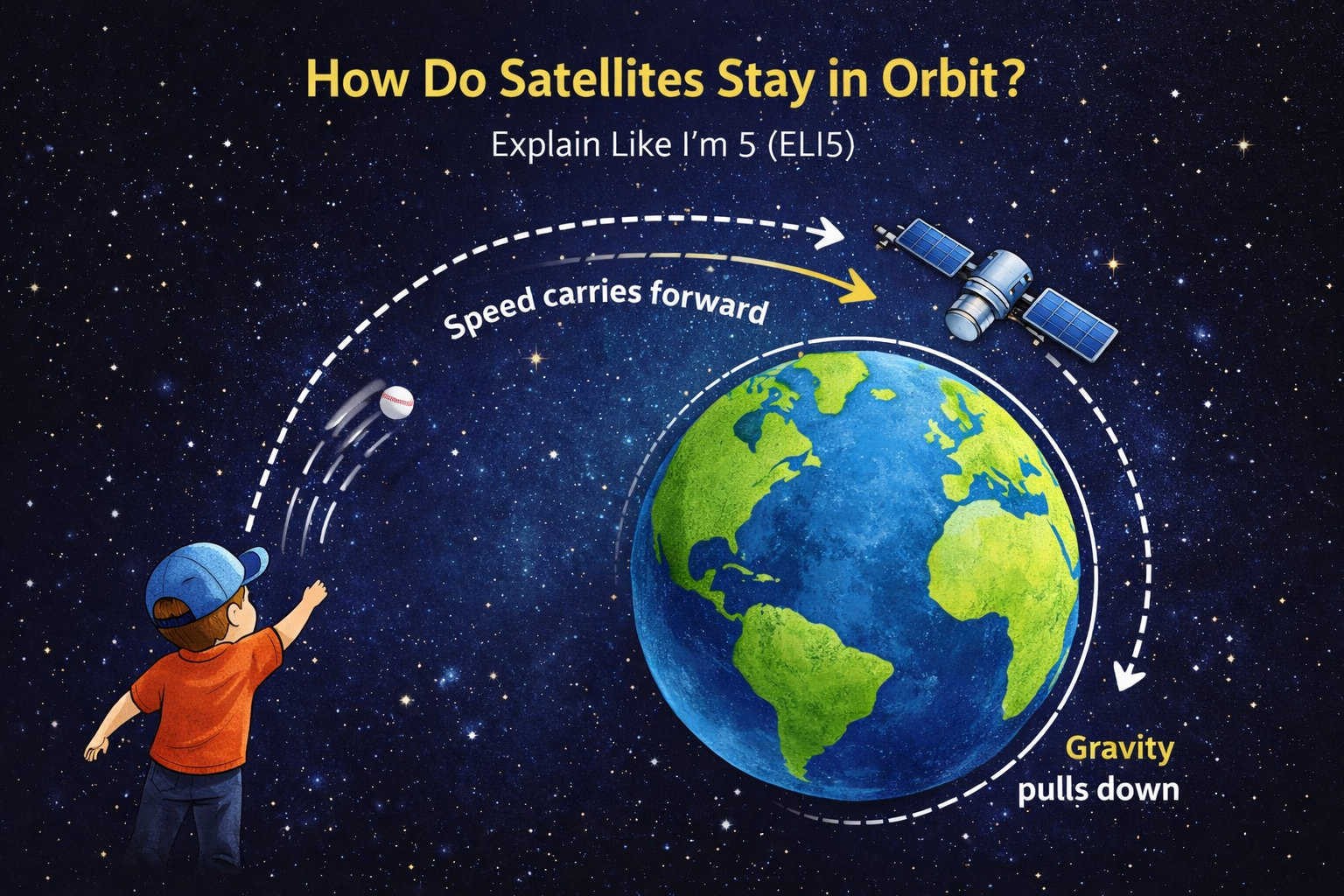
If you throw a baseball, it falls to the ground. If you throw it harder, it goes farther. If you could throw it fast enough and there were no air to slow it down, it would keep falling around Earth instead of dropping straight back to you. That is, in plain English, how a satellite stays in orbit.
A satellite is not “floating” above Earth the way a balloon floats in the air. It is falling all the time. The trick is that it is also moving sideways so fast that, as it falls, the ground curves away beneath it. Earth pulls the satellite downward with gravity, while the satellite's forward speed keeps it from crashing straight in. Orbit is the balance between those two things: gravity pulling down, speed carrying forward.
Orbit is just falling sideways.ISN editorial shorthand for orbital motion
The Playground Merry-Go-Round Version
Imagine running across a playground while throwing a ball sideways. If you throw it gently, it lands near your feet. If you throw it harder, it lands farther away. If the playground were magically curved like a tiny planet, and you threw it very fast, the ball would keep missing the ground because the ground would keep dropping away under it. That is orbit.
The basic physics are stable: satellites in lower orbit move faster than satellites in higher orbit, because the lower they are, the stronger Earth's gravity is and the more sideways speed they need to keep missing the planet.
Why Satellites Do Not Need Their Engines On All The Time
This is one of the biggest misconceptions. People often imagine a satellite like an airplane, continuously firing its engines to stay up. But a satellite in orbit usually spends most of its life coasting.
Think of riding a bicycle down a long, smooth hill. You might pedal a little at the start, but once you have enough speed, you mostly glide. A satellite works similarly: the rocket gives it the speed it needs to reach orbit, and then the satellite keeps going because there is almost no air in space to slow it down.
That is why launch is so hard and so expensive. The difficult part is not “holding” a satellite up in space. The difficult part is giving it enough sideways speed in the first place.
Gravity Is Not Gone
Another common misunderstanding is that satellites stay up because there is “no gravity” in space. There is plenty of gravity in low Earth orbit. In fact, the International Space Station and most Earth-observing satellites are still very much under Earth's gravitational pull. They are not free from gravity; they are in continuous free-fall around Earth.
That is also why astronauts float. They are not floating because gravity disappeared. They are floating because they, their spacecraft, and everything inside it are all falling together at the same rate.
Low Orbit, High Orbit, and Why Height Changes Everything
Not all satellites orbit the same way. Some are relatively close to Earth in low Earth orbit, often called LEO. These are commonly used for Earth imaging, weather data, reconnaissance, and large broadband constellations. LEO is crowded because it is useful: satellites there are closer to the ground, which means faster data links, better imaging detail, and cheaper launches compared with very high orbits.
Some orbit much higher, including geostationary orbit, where a satellite circles Earth at exactly the same rate Earth rotates. From the ground, it appears to stay in one fixed spot in the sky. That is especially useful for communications and weather coverage over large areas.
Here is the easiest way to think about it: lower orbit means closer, faster, and more frequent passes over the same area. Higher orbit means farther, slower, and broader coverage. A satellite in low orbit zips around Earth in roughly 90 minutes or so. A geostationary satellite takes about 24 hours, matching Earth's rotation, which is why it seems stationary from the ground.
Why Satellites Do Not Stay Up Forever Without Help
Some do not. Whether a satellite stays up for years or eventually falls back depends on where it is and what forces act on it.
First: drag. Even in low Earth orbit, there is still a tiny amount of atmosphere. Not enough for humans to breathe, but enough to create drag over time. That drag slowly steals speed. When a satellite loses too much speed, gravity wins, the orbit decays, and the satellite reenters Earth's atmosphere. That is why very low satellites often need occasional boosts.
Second: tiny gravitational nudges. Earth is not a perfect smooth ball. The Moon pulls. The Sun pulls. Even the shape of Earth and the distribution of its mass create small orbital effects over time. For long-lived spacecraft, those nudges add up.
Third: mission design. Some satellites are built to stay in orbit for many years. Others are meant to deorbit at the end of their mission so they do not become long-term debris.
A satellite stays in orbit because it is moving sideways so fast that, while gravity keeps pulling it downward, Earth keeps curving away beneath it.
What Staying in Orbit Means Operationally
For operators, “staying in orbit” does not just mean “not crashing.” It means staying in the right orbit. A communications satellite may need to hold a precise slot. An Earth-observation satellite may need a repeatable path over the same places. A reconnaissance satellite may need a specific geometry for coverage and revisit timing. A navigation satellite must maintain a tightly controlled orbital pattern so timing and positioning stay accurate.
So the real job is less like “keep it up there” and more like “keep it exactly where the mission needs it to be.” That is where onboard thrusters matter. They are not constantly blasting away like a movie spaceship, but they are used for station-keeping, orbit adjustment, collision avoidance, and end-of-life disposal.
Why Satellites Sometimes Need to Move
Space is not empty in the practical sense. It is increasingly busy. Operators maneuver satellites to avoid debris, avoid another spacecraft, maintain formation in a constellation, shift to a better operating position, or prepare for deorbit.
That matters more now because the orbital environment is getting more crowded, especially in LEO, where broadband constellations and imaging fleets are scaling quickly. ISN's coverage of launch cadence, Starlink, and the broader commercial space economy points to the same underlying reality: space is increasingly infrastructure, not spectacle.
Why the Rocket Matters More Than the Satellite at First
A satellite stays in orbit because the launch system gave it the right starting conditions. That means the rocket has to do two things: get high enough and get fast enough sideways.
Height alone is not enough. If you carried a satellite straight up and simply let go, it would come right back down. Orbit is mostly a speed problem. That is why launch providers talk so much about insertion accuracy. If the satellite enters the wrong orbit — too low, too elliptical, slightly off inclination — the spacecraft may have to spend its own fuel correcting the mistake, which can shorten mission life.
Why This Matters Beyond the Science
This is not just a schoolbook physics question anymore. Modern economies depend on satellites for communications, navigation, weather forecasting, imaging, military awareness, financial timing, and internet access. That is why commercial launch, constellation deployment, national security space, and lunar and cislunar infrastructure are now treated more like critical systems than science projects.
Understanding orbit is the first step to understanding almost everything else in the space sector: why launches are expensive, why constellations need thousands of satellites, why debris matters, why low orbit is crowded, why military and commercial operators care so much about orbital control, and why the next generation of space business is really about managing movement, position, and access above Earth.
An Editorial Reflection
The strange beauty of orbital mechanics is that something that looks impossibly advanced is built on a childlike idea: throw something sideways hard enough, and it keeps missing the ground. Of course, in the real world, “hard enough” means hypersonic velocity, exact insertion, station-keeping fuel, collision management, and a global industrial base of rockets, software, sensors, and operators. But the core idea never changes.
Satellites stay in orbit because gravity never stops pulling, and speed never quite lets them come home.
This article targets: satellites stay in orbit, how satellites work, LEO orbit, geostationary orbit, gravity and orbital speed, space basics for kids, satellite station-keeping, orbital mechanics explained, space infrastructure, and commercial satellite constellations.