
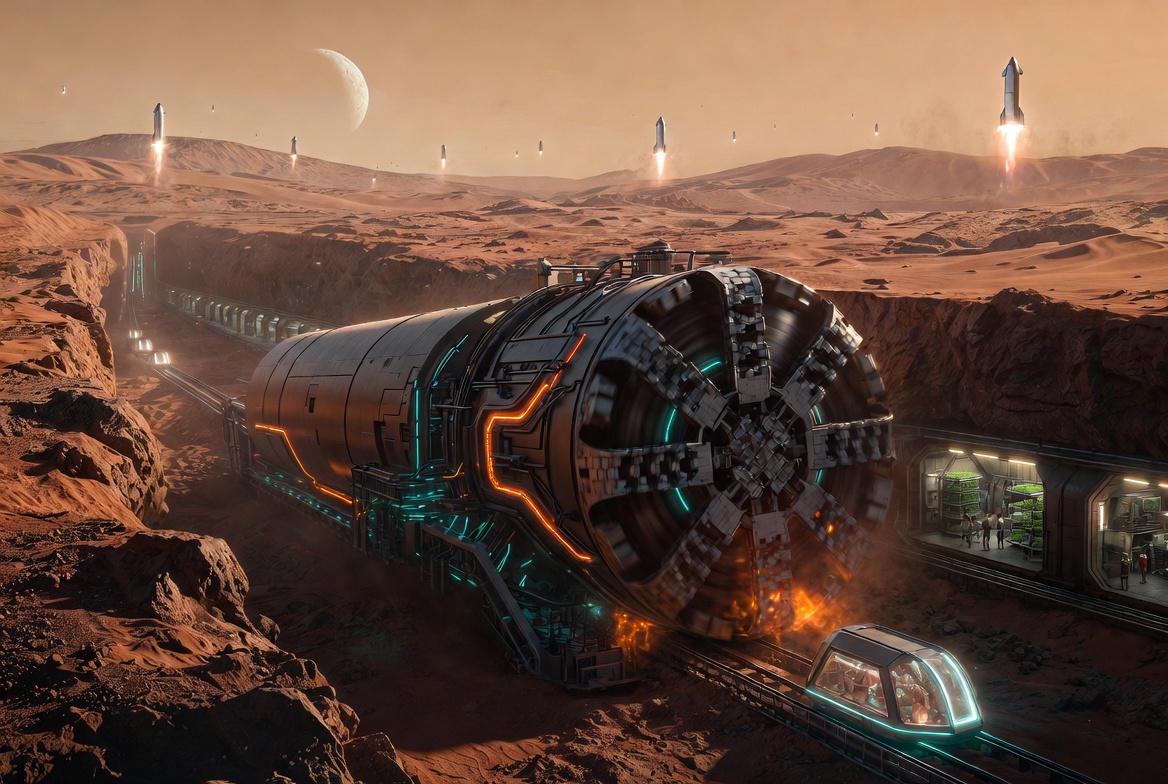
Mars looks like the kind of place where human settlements should rise visibly against the horizon. The instinct makes sense. Domes, pads, and stacked habitat modules are easy to picture, and they make for elegant concept art. But if the job is not to visit Mars, but to stay there, the logic shifts. The strongest case may be for going down, not up.
Underground settlement changes the problem from exposure management to infrastructure design. On Mars, that matters. Radiation is persistent. Temperatures swing hard. Dust gets into everything. And unlike Earth, Mars does not offer a thick atmosphere or a global magnetic field to soften the environment for you.
Mars is safer below the surface than above it. Tunnels and buried habitats could protect crews from radiation, dust, and temperature extremes while creating a settlement that can expand room by room instead of relying on fragile exposed structures.
Why the surface is the problem
Mars is visually inviting in a way that can mislead. It has terrain, seasons, and a horizon that feels almost familiar. Operationally, though, the surface is harsh and unforgiving for long-duration human habitation. Every exposed structure has to fight radiation, dust, thermal cycling, and impact risk at the same time.
That does not mean the surface is useless. Landers, power systems, antennas, and industrial hardware will still need to operate there. But it does suggest that a permanent settlement strategy built mainly around exposed structures may be solving the wrong problem.
If the goal is durability, the first design question is not how impressive a habitat looks from orbit. It is how much protection it can deliver from the environment around it.
If Mars becomes livable at scale, it may be because settlers stopped thinking like architects of outposts and started thinking like builders of underground infrastructure.ISN Editorial Board
Why underground habitats make engineering sense
The appeal of subsurface construction on Mars is straightforward. A layer of regolith overhead provides shielding. A tunnel network reduces exposure during routine movement. Buried infrastructure is easier to harden, easier to connect, and potentially easier to expand over time than isolated above-ground modules.
That matters because real settlement is not a single habitat. It is a system. Living quarters, life-support zones, storage, agriculture, maintenance spaces, labs, and mobility corridors all need to work together. Underground design turns separate structures into a protected interior environment.
In that framework, the question is no longer whether tunnels are useful. It is how quickly and reliably they can be created at scale.
Why The Boring Company enters the conversation
That is where The Boring Company becomes relevant. On Earth, its public identity has centered on urban tunnel systems, cost reduction, and faster boring operations. Those are terrestrial goals, but the technical lessons map surprisingly well onto one of Mars settlement’s hardest constraints: protected volume.
The strategic value is not that a current machine could be dropped onto Mars as-is. It is that repeated work on boring speed, deployment, launch and retrieval methods, tunnel operations, automation, and cost discipline could form the basis of a future Mars-specific system.
The deeper significance is conceptual. If rapid tunneling becomes cheaper and more repeatable, then underground construction shifts from a niche option to a primary settlement architecture.
Why Mars may reward boring more than building upward
Early Mars concepts often emphasize visible structures because they are intuitive. Domes, pads, and stacked modules look like settlement. But an underground network may be more realistic because it prioritizes protection first and aesthetics never.
A buried habitat can be expanded incrementally. New branches can be added without exposing crews to routine transit risk. Equipment can be distributed through connected corridors. Pressurized sections can be compartmentalized for resilience. Industrial activity can be separated from habitation while remaining within one operational envelope.
In other words, tunneling does not just create shelter. It creates urbanism. Even a small network starts to behave less like a camp and more like a settlement.
Natural lava tubes and machine-cut tunnels are not competing ideas
Mars may already offer some large underground spaces in the form of lava tubes. These features have long attracted interest because they could provide natural shielding and large internal volumes. But natural voids do not eliminate the need for engineered infrastructure.
If lava tubes are usable, they would still need access routes, internal stabilization, environmental control, and logistics connections. If they are not ideally located, machine-cut tunnels may be the better answer. More likely, a mature settlement strategy would use both: natural formations where they make sense, engineered excavation where precision and connectivity matter more.
That blended model is one reason tunneling deserves more attention in Mars planning. It is compatible with multiple settlement pathways rather than tied to a single architectural vision.
The hard part is not the concept. It is adaptation.
None of this should be mistaken for simplicity. Mars is not Nevada. Soil mechanics differ. Ice content may vary by region. Dust behavior, thermal stress, sealing methods, power availability, autonomy requirements, and maintenance cycles would all shape what a practical excavation system looks like off-world.
Mass and volume constraints would matter from the start. Any machine sent to Mars would need to justify its launch cost, operate with limited local support, and probably rely on a high degree of automation. A settlement-grade boring platform would need to be more than fast. It would need to be repairable, modular, and deeply integrated into the larger surface logistics chain.
That does not weaken the case. It clarifies it. The path to Mars tunneling is not about repurposing an Earth product unchanged. It is about using terrestrial iteration to reduce the unknowns before a specialized Martian version is built.
Was this always the long game?
It is tempting to read a hidden master plan into any infrastructure effort associated with Elon Musk’s broader multiplanetary ambitions. There is some logic to that instinct. Tunneling solves immediate Earth problems, but it also develops capabilities that could be valuable on Mars.
Still, the more useful question is not whether every step was secretly aimed at Mars from the beginning. The more useful question is whether the capability now exists in a form that makes Mars settlement thinking sharper. On that measure, the answer appears to be yes.
The Boring Company’s work suggests that underground construction can be treated as a speed, cost, and systems-engineering problem rather than as a one-off civil works exercise. That framing has real implications for Mars, whether or not it was the original point.
Why this matters for the next phase of Mars planning
The conversation about Mars often gets pulled toward launch cadence, landing systems, and mission spectacle. Those are essential pieces. But long-term presence depends just as much on what happens after arrival. Shelter, protected mobility, and scalable infrastructure will determine whether a landing becomes a foothold or just another temporary visit.
That is why tunneling belongs closer to the center of the Mars architecture debate. It addresses multiple threats at once. It supports modular growth. And it points toward a version of settlement that is operationally coherent, not just visually persuasive.
If humans establish a durable presence on Mars, the decisive technology may not be the one that brings people there. It may be the one that lets them stop living as guests on the surface and start building a protected interior world beneath it.