
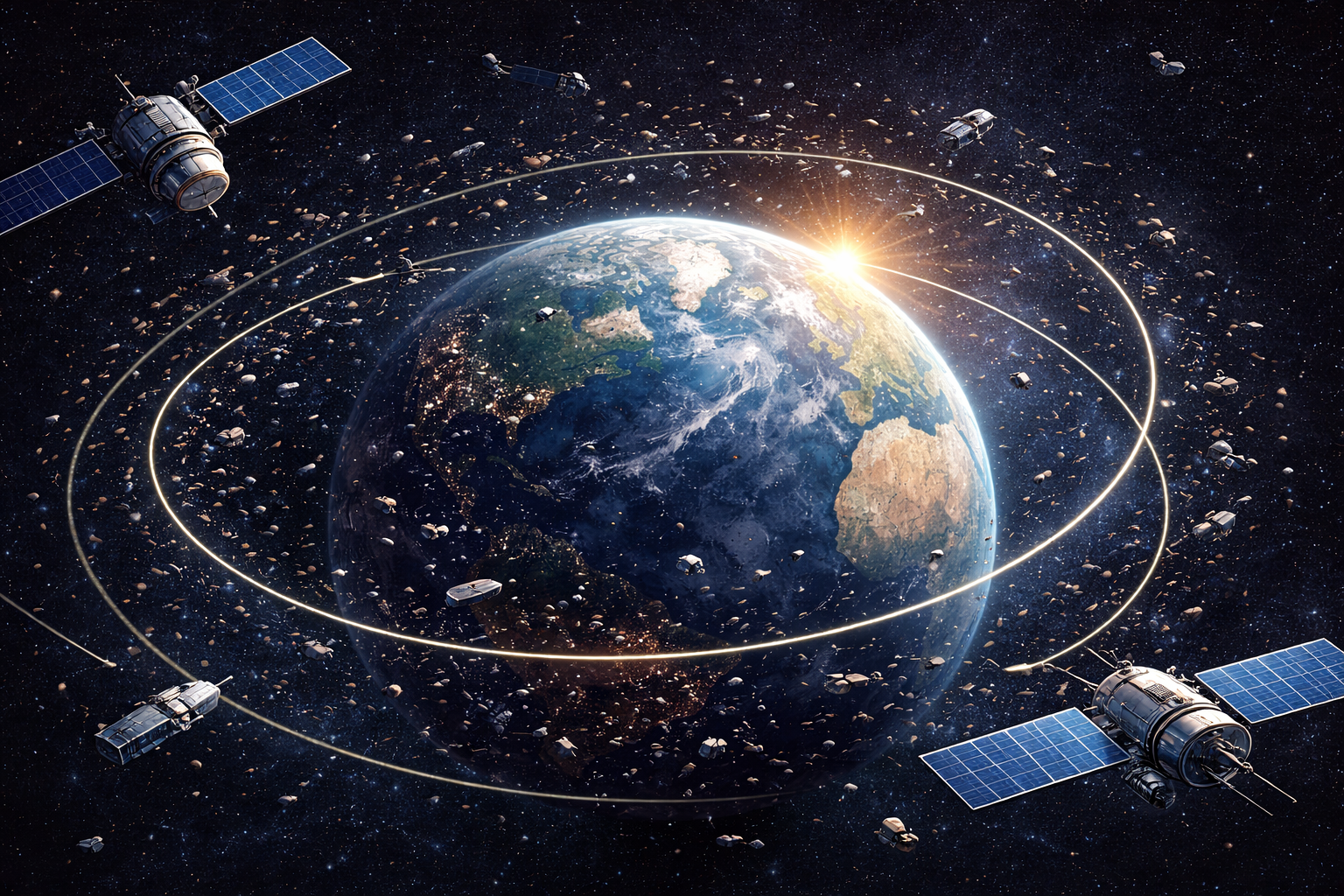
Orbital congestion and space debris are serious problems, but they are often described in the wrong register. On one side, the issue is reduced to a vague environmental concern. On the other, it is framed like an immediate apocalyptic cascade that could shut down space activity overnight. Neither description is especially useful.
The reality is more operational and more important. Low Earth orbit is getting busier. Satellite constellations are scaling. Launch cadence is rising. The number of close approaches, conjunction alerts, and maneuver decisions is increasing. Debris is not just a future cleanup issue. It is already part of routine mission planning, insurance analysis, military and defense space operations, and commercial satellite economics.
The most immediate danger is not a Hollywood-style debris storm. It is a steady increase in operational friction that makes space systems harder, costlier, and riskier to run.ISN editorial shorthand for the congestion problem
How serious is the problem?
It is serious enough that operators already plan around it. That alone should settle the question. If satellite companies, governments, launch providers, and military organizations are spending time, software, fuel, and money on collision avoidance, the problem is real.
But seriousness does not mean uniform crisis. The orbital environment is not equally congested everywhere. Some altitudes and inclinations are far more crowded than others. Low Earth orbit, particularly in regions attractive for broadband, Earth observation, remote sensing, and national security missions, is where the pressure is most visible.
The growth of large constellations matters here. More satellites mean more conjunction assessments, more traffic management demands, and more chances for poor coordination, software error, or bad end-of-life disposal. In that sense, congestion is not just about debris fragments already in orbit. It is also about how many active spacecraft are competing for safe, sustainable access to the same orbital bands.
How immediate is it?
The immediate problem is not that all of space is about to become unusable. The immediate problem is that the orbital environment is becoming more operationally expensive and less forgiving.
That shows up in practical ways. Operators need more accurate tracking. Satellite fleets need propellant margins for maneuvering. Mission teams need automated conjunction screening and response workflows. Launch providers must assess traffic in destination orbits. Insurers and investors need to price risk that used to feel remote.
The near-term clock is therefore measured less in catastrophe and more in friction. If congestion continues to rise faster than coordination and mitigation improve, then every new mission enters a more complex operating environment. That affects commercial space, Earth observation, military systems, and civil programs alike.
Orbital congestion is already a real operational problem. Space debris is not likely to end space activity tomorrow, but it is increasing cost, complexity, and risk right now, especially in low Earth orbit.
Why debris is different from congestion
Congestion and debris are related, but they are not identical. Congestion includes active satellites, launch traffic, coordination failures, and the basic crowding of useful orbits. Debris refers to nonfunctional objects and fragments that cannot maneuver at all.
That distinction matters because active satellites can, in principle, coordinate, communicate, and move. Debris cannot. Once fragments are created, they become persistent hazards that other spacecraft must avoid. In some cases, they can remain in orbit for years or far longer, depending on altitude.
This is why major fragmentation events matter so much. A single anti-satellite test, accidental collision, or breakup can create a long tail of risk. That is not because every fragment will cause disaster immediately. It is because those fragments multiply the number of objects that future operators must track and avoid.
Who is actually trying to solve it?
No single actor is solving orbital congestion and space debris. The response is fragmented, which is part of the problem.
Governments handle tracking, regulation, licensing, and national security monitoring. Civil agencies and space regulators shape debris mitigation rules, disposal expectations, and traffic norms. Commercial operators are building better collision-avoidance software, autonomous maneuvering systems, and constellation management tools. A smaller group of companies is focused directly on active debris removal and on-orbit servicing.
The challenge is that the orbital environment is shared, while incentives are often local. One operator may do everything right and still face debris created by someone else decades earlier. That means debris mitigation depends heavily on standards, enforcement, transparency, and international behavior, not just engineering.
This is one reason ISN's wider coverage of satellite infrastructure, launch cadence, and defense-space activity matters. Orbital sustainability is not a side issue. It now sits directly inside the economics and security logic of the space sector.
What solutions are being proposed?
The solution set falls into four broad categories: prevent new debris, improve tracking, move satellites responsibly, and remove dangerous objects where possible.
Prevention is the most obvious and, in many ways, the most feasible. Design spacecraft to avoid explosions and breakups. Require passivation of leftover fuel and batteries. Improve disposal planning. Discourage destructive anti-satellite testing. Build satellites that can deorbit reliably at end of life.
Better tracking and traffic coordination is also essential. Operators need higher-quality space domain awareness, better conjunction data, and clearer rules for who maneuvers when. This does not remove debris, but it reduces collision risk and operational confusion.
Responsible maneuvering and disposal is the next layer. Constellations and satellite operators need robust station-keeping, collision avoidance, and disposal execution. A dead spacecraft that fails to deorbit cleanly becomes tomorrow's hazard.
Active debris removal gets the most public attention because it is visually intuitive: go capture dangerous junk and remove it. The problem is that it is technically difficult, legally sensitive, and economically weak unless governments or regulators pay for it directly. Debris removal may be necessary for selected high-risk objects, but it is unlikely to be the sole answer.
Which solutions are actually most feasible?
The most feasible solutions are usually the least cinematic.
The highest-value actions in the near term are stronger mitigation rules, better compliance, better tracking, and more disciplined end-of-life disposal. Those measures do not sound dramatic, but they reduce the rate at which the problem gets worse. That matters more than any single cleanup mission.
Active debris removal is feasible in narrow terms, especially for very large dead objects in strategically important orbits. But it is not yet a broad economic solution. The business case is hard because debris usually does not belong to the company trying to remove it, and the liability, ownership, and funding questions are complex.
In other words, the most feasible path is probably layered: prevent new debris first, improve space traffic management second, and use active removal selectively where the risk justifies the cost.
What role do military and defense systems play?
A large one. Military and defense space missions depend on reliable access to orbital systems for communications, missile warning, ISR, positioning, navigation, and timing. Congestion and debris therefore are not just commercial headaches. They are national security issues.
This cuts two ways. Defense organizations often have the best incentives to take orbital risk seriously because mission failure can have strategic consequences. At the same time, military behavior — including testing, deterrence signaling, and crisis activity — can shape the debris environment for everyone.
That is why the problem cannot be solved only as an environmental or commercial issue. Orbital congestion sits at the intersection of commercial space, space policy, national security, and international norms.
What should readers take seriously right now?
The right takeaway is not panic. It is discipline.
Orbital congestion and space debris are already making the space economy harder to operate. The risk is not abstract. It shows up in maneuver costs, launch planning, compliance burdens, insurance pricing, and long-term uncertainty over the sustainability of key orbital regimes.
That makes this an immediate issue in one important sense: every new satellite launched into a crowded orbit joins an environment shaped by decisions already made. If mitigation improves, the sector can manage the problem. If not, the cost of operating in orbit will rise, and some orbits will become progressively less attractive or less safe for the missions that depend on them.
The most realistic answer, then, is that orbital congestion is serious now, debris is a worsening long-horizon threat, and the best solutions are the least glamorous ones: prevention, tracking, coordination, enforcement, and disposal discipline. Cleanup missions may matter. But the real test of orbital sustainability is whether the sector can stop creating avoidable hazards faster than it can invent ways to remove them.
This article targets: orbital congestion, space debris, space traffic management, satellite safety, low Earth orbit, military and defense space, debris mitigation, and orbital sustainability.