
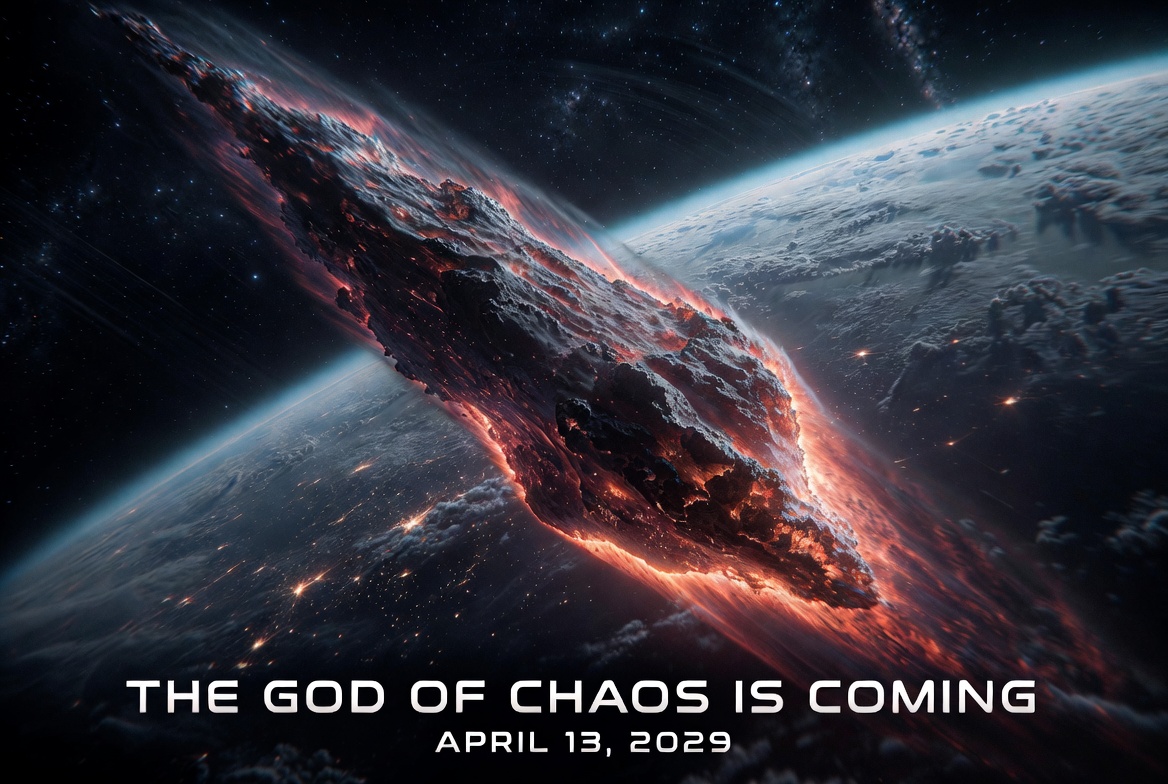
When asteroid 99942 Apophis was discovered in 2004, early calculations briefly suggested a troubling possibility: an impact with Earth on April 13, 2029. The odds were small, but not small enough to ignore. For a short time, Apophis became a symbol of how little margin there can be between scientific uncertainty and public alarm.
The nickname helped. Named after the Egyptian figure associated with chaos and destruction, Apophis entered the public imagination as a cosmic threat with mythic branding. That framing was dramatic, but the science kept moving. More observations narrowed the uncertainty, and the danger case fell away.
Today, Apophis stands as a useful corrective. It is not the asteroid that will turn our world upside down in 2029. It is the asteroid that showed why persistent tracking matters.
Apophis will pass very close to Earth in April 2029, but it is not expected to hit us. The real story is that scientists will get an unusually good chance to study how a large asteroid behaves during a close planetary flyby.
What makes the 2029 pass extraordinary
Apophis is large enough to command attention. At roughly 340 to 375 meters across, it is not a small fragment. It is a substantial near-Earth asteroid, elongated in shape, rocky in composition, and old enough to preserve clues from the early solar system.
What sets this event apart is distance. On Friday, April 13, 2029, Apophis is expected to pass within about 32,000 kilometers of Earth's surface. That is closer than many geosynchronous satellites. Encounters this close, involving an asteroid of this size, are rare on human timescales.
For observers across parts of Europe, Africa, and western Asia, Apophis should be visible to the naked eye as a moving point of light. That matters not just for public interest, but for public understanding. Few space events make orbital mechanics feel so immediate.
Apophis is no longer a disaster scenario. It is a live demonstration of why planetary defense depends on patience, precision, and sustained observation.ISN Editorial Board
Why scientists are confident it will miss Earth
Confidence did not come from wishful thinking. It came from measurement. Repeated optical observations, combined with radar work, refined the asteroid's orbit to a high degree of precision. That changed Apophis from a headline risk into a well-characterized object.
This is the part of the story that deserves more attention. Planetary defense is often presented as a movie plot. In practice, much of it is quieter. It is observational astronomy, orbit determination, follow-up campaigns, data revision, and years of cumulative work that steadily reduce uncertainty.
The result is reassuring but also instructive. A near-term impact is not expected. That does not make the object irrelevant. It makes it measurable, and therefore useful.
A natural experiment in asteroid physics
A close flyby is not just a spectacle. It is a physical event. Earth's gravity will tug on Apophis during the encounter, subtly altering its orbit and potentially affecting its surface. Researchers want to know how much that matters.
Tidal forces could shift loose material, trigger small landslides, or expose fresher layers beneath weathered surface dust. If that happens, scientists will be able to compare the asteroid before and after the flyby and watch how a near-Earth object responds to planetary stress.
That kind of opportunity is rare. Usually, close inspection of an asteroid requires a dedicated mission built around years of travel and a narrowly defined target. In this case, the asteroid is effectively bringing the experiment to Earth's neighborhood.
Why missions to Apophis matter beyond curiosity
The 2029 flyby is expected to attract coordinated scientific attention from multiple missions and observation networks. The European Space Agency's Ramses mission is designed to study Apophis before and during the encounter. NASA's OSIRIS-APEX mission, repurposed from the OSIRIS-REx program, is expected to examine the asteroid after the closest approach.
That sequencing matters. Scientists are not just trying to see Apophis. They are trying to detect change. Surface motion, reshaped terrain, new exposure patterns, or altered rotation would all improve our understanding of how asteroids behave under stress.
That knowledge feeds directly into planetary defense. If humanity ever needs to redirect a hazardous object, the key question will not be abstract. It will be practical: how does this material respond when force is applied?
What still makes Apophis worth watching
Calling the 2029 pass safe does not mean declaring the long-term story finished. Apophis remains part of the broader population of potentially hazardous asteroids, and long-horizon orbital evolution is shaped by more than a single close approach.
Small effects can accumulate over time. Uneven heating can produce tiny thrust forces. Future gravitational encounters can compound subtle changes. Over centuries and millennia, those details matter. Space is predictable enough for science, but not so simple that vigilance becomes optional.
That is the healthy lesson here. We do not need fear to justify asteroid monitoring. We need continuity.
A close call without catastrophe is still a major story
Apophis is compelling precisely because it does not fit the usual script. It is not an immediate threat, yet it will pass close enough to feel personal. It is ancient, silent, and harmless in the near term, but it will also test our ability to observe, interpret, and explain a complex celestial event in real time.
That makes it an editorial story as much as a scientific one. The public does not only need warnings when danger is high. It also needs literacy when danger is low but significance is high. Apophis offers that chance.
In 2029, millions of people may look up and see what appears to be a bright moving star. What they will really be seeing is decades of orbital science made visible. That is not chaos. That is competence, with humility intact.