
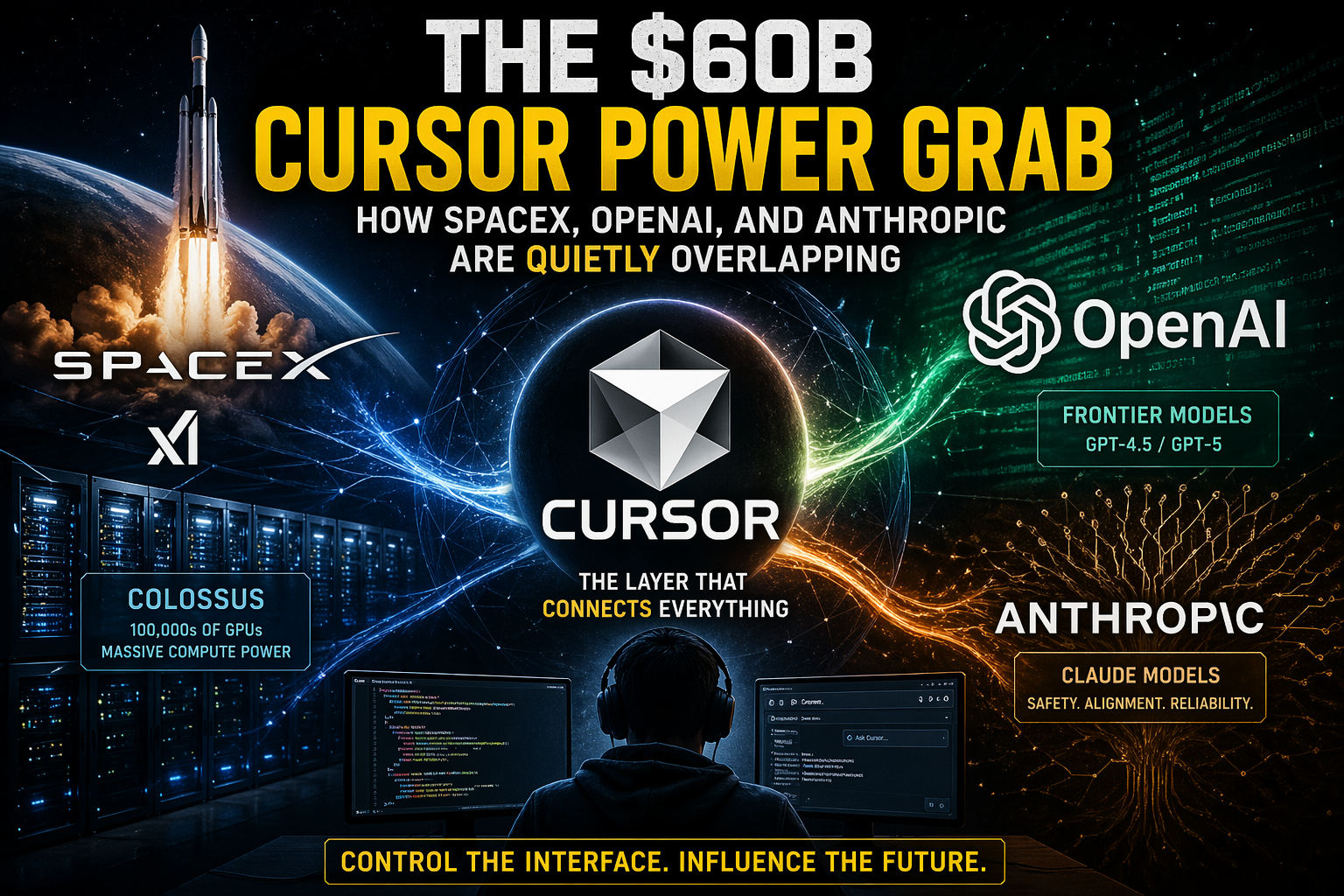
On April 21, 2026, SpaceX announced one of the strangest and most strategically revealing deals of the AI era: a partnership with Cursor, the coding platform built by Anysphere, that gives SpaceX the option to acquire the company later in the year for $60 billion. If the acquisition does not happen, SpaceX would instead pay $10 billion for the collaboration.
The headline number is enormous. But the deeper story is not the size of the option. It is the layer of the stack Cursor occupies.
Cursor is not just another startup building on top of AI hype. It sits in the developer workflow itself. It is the place where models become behavior: where coders decide what to ask, which system to trust, how much autonomy to hand over, and which vendor becomes part of daily work. That is why this deal matters. SpaceX is not just trying to buy an application. It is trying to buy a chokepoint.
What makes the move especially interesting is that Cursor has never been a closed ecosystem. Its own documentation makes clear that the product supports models from OpenAI, Anthropic, Google, xAI, DeepSeek, and Cursor’s own offerings. Cursor’s “Auto” setting even chooses among premium models based on task fit and reliability. In other words, the product’s appeal has been built partly on being a gateway across model vendors rather than a captive front end for one of them.
Cursor matters because it sits between developers and the models they choose. If SpaceX owns Cursor, it may gain influence over which AI systems become the default tools for serious work.
Why the overlap matters
That neutrality, or at least that multi-model flexibility, is precisely what becomes strategically valuable once one ecosystem tries to control it.
SpaceX said the partnership combines Cursor’s “product and distribution to expert software engineers” with the Colossus supercomputer. Reuters and TechCrunch both reported the same broad structure: a development partnership now, an option to buy later, and a fallback payment if the acquisition does not close. The company’s public framing is ambitious but straightforward. SpaceX wants a stronger position in AI coding and “knowledge work” systems, an area where OpenAI and Anthropic have become deeply embedded in the developer market.
This is why the OpenAI/Anthropic overlap matters.
Cursor did not become important by locking itself to one model family. It became important by meeting developers where they already were, offering access to frontier coding models from multiple providers while adding its own interface, context handling, workflow logic, and product decisions on top. That means the company already sits at an intersection where the major labs overlap in practice, even if they compete fiercely in public.
Most public AI coverage still treats the market as a model race. But the larger advantage may belong to whoever controls the layers where real work happens.ISN Editorial Board
Control the interface, influence the default
SpaceX, through xAI and its compute ambitions, is now trying to step directly into that overlap. Instead of merely building better models, it is moving toward something potentially more durable: control over the environment in which models are chosen, compared, switched, and operationalized by users.
That is a different kind of power.
Most public AI coverage still treats the market as a model race — who is smartest, fastest, cheapest, safest, or most capable. But many of the largest long-term advantages may belong not to the model makers alone, but to whoever controls the layers where real work happens. The interface matters. The workflow matters. The default button matters. The fallback model matters. The product that decides when one model is “good enough” and when another should take over matters a great deal.
Cursor already does some of that. Its documentation says the product can automatically pick premium models based on demand and reliability. That may sound like a product detail, but it is strategically loaded. Once an interface determines which provider gets surfaced, which system gets trusted for high-value tasks, and when users are nudged from one model family to another, that interface becomes part of the market structure itself.
Compute plus distribution
The compute side only makes the overlap more consequential. Reuters reported that the partnership gives Cursor access to the Colossus supercomputer cluster, strengthening the company’s ability to build or refine its own AI capabilities. TechCrunch, citing SpaceX, said Colossus has the equivalent of roughly a million Nvidia H100s. Whether one takes that specific framing literally or as branding, the strategic point is clear: SpaceX wants to pair massive compute with direct developer distribution.
That combination changes the nature of competition. A company that controls both compute and the interface no longer needs to win purely by building the single best model in every benchmark category. It can influence default usage patterns, shape developer habits, and gradually tilt an ecosystem around its own stack.
That does not mean Cursor instantly stops being multi-model. In fact, its current value depends on exactly the opposite. But if SpaceX eventually owns the company, the question becomes less whether the interface still can connect to OpenAI and Anthropic models and more whether it remains economically or strategically neutral in how those models are surfaced.
The middle layer is the real battleground
This is also why the fallback structure of the deal matters. Even if a full acquisition never closes, a $10 billion collaboration payment is still large enough to signal something unusual: this is not a tentative pilot program. It is a serious effort to bind distribution, product, and compute together before the next phase of AI platform competition hardens.
And the timing is hard to ignore. Reuters said the move comes ahead of SpaceX’s much-anticipated IPO, which some investors expect to become one of the largest public offerings in history. Even stripped of the valuation chatter, the identity shift is real. SpaceX is no longer just a launch company with a side interest in Musk’s adjacent ventures. It is moving toward a position where space infrastructure, AI infrastructure, and software workflow control all begin to overlap.
That overlap is the real story.
What gets owned next
OpenAI, Anthropic, and xAI still compete on philosophy, product design, safety posture, and model capability. But the market is no longer cleanly separable into “labs” and “apps.” The same companies increasingly overlap through model access, infrastructure, talent movement, and the interfaces through which users actually work. Cursor sits right in the middle of that convergence.
So the biggest question raised by the SpaceX-Cursor deal is not whether a $60 billion option is expensive. It is whether there is still such a thing as an independent layer in AI.
If the companies building the models also control the compute, the developer interface, and the distribution channel through which those models reach users, then “competition” starts to look less like separated lanes and more like a small number of overlapping control systems.
That does not make the deal irrational. It may make it brilliant. But it should also make people more honest about what kind of market is taking shape.
The strategic value of being the gatekeeper
Cursor may be worth so much not because it is one more AI tool, but because it occupies one of the last places where model choice still feels fluid. If SpaceX captures that layer, it will not just own a coding product. It will own a piece of the terrain where developer behavior, AI defaults, and competitive power all meet.