
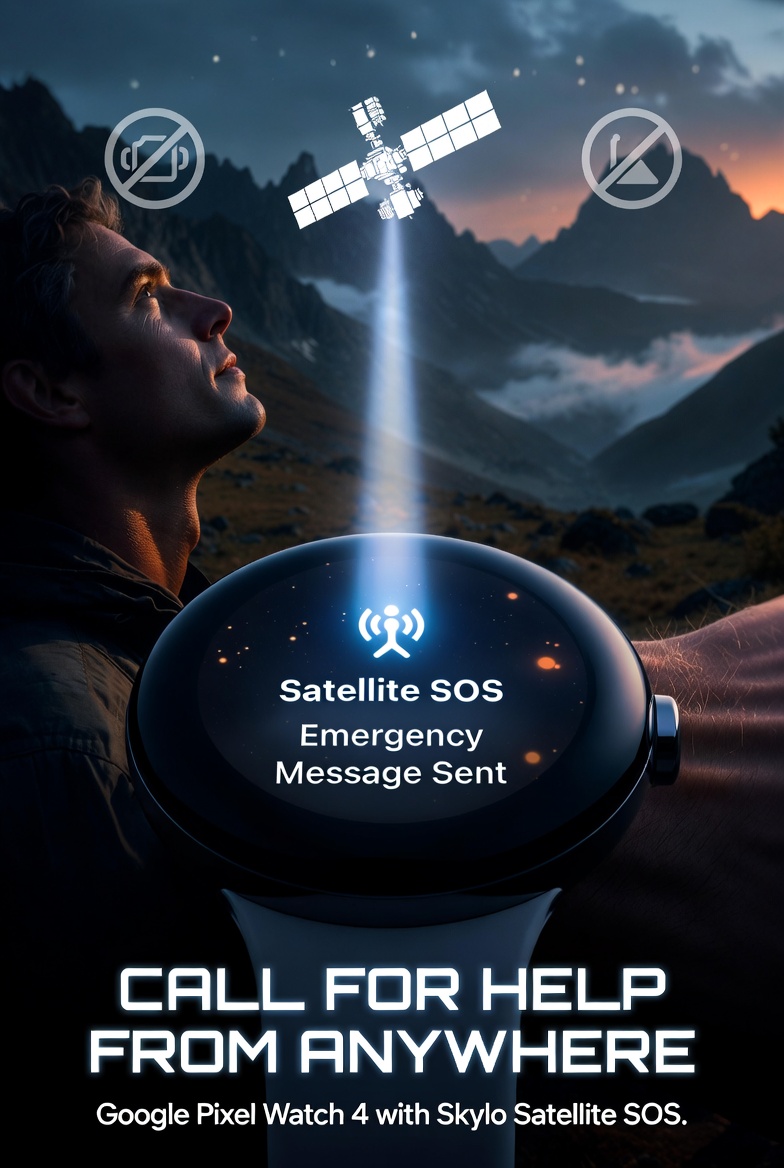
The significance of satellite SOS on a smartwatch is easy to miss if it is treated as just another premium feature. It is more consequential than that. A wearable is physically with the user in moments when a phone may be packed away, drained, damaged, or simply not nearby. That makes emergency communication from the wrist a meaningful shift in device independence.
In practical terms, the Pixel Watch 4 moved satellite emergency messaging from the phone category into the wearable category. That is a notable step because the technical and user-interface constraints are much tighter on a watch. Smaller battery, smaller screen, smaller antenna envelope, and harder alignment all make the problem more demanding.
The accomplishment is not just that the feature exists. It is that it exists in a form ordinary users can understand under stress.
Satellite SOS on a smartwatch means you can try to contact emergency services even when regular phone and Wi-Fi networks are unavailable. That makes a watch more than a companion device. In the right conditions, it becomes a last-resort communications tool.
Why Skylo matters in this story
Skylo is important because it represents a broader model for satellite connectivity. Rather than building a consumer device and then asking users to think about orbital infrastructure, Skylo works in the background as the network layer that helps compatible devices reach satellites when terrestrial coverage fails.
That is strategically significant. It suggests the next phase of satellite connectivity may be less about visibly specialized hardware and more about quietly embedding non-terrestrial networking into products people already understand. In that model, a watch or phone does not become a satellite device in the dramatic sense. It simply becomes more capable when conditions require it.
That is how these features tend to go mainstream: not as spectacle, but as resilience.
The important breakthrough is not that a watch can reach a satellite. It is that emergency connectivity is starting to feel like a built-in layer of personal technology rather than a separate category of expedition gear.ISN Editorial Board
Why this matters beyond marketing
Most smartwatches are still heavily dependent on the network assumptions of everyday urban life. They are useful on the grid, less useful at the edge, and often weakest exactly where emergency communication becomes most valuable. That is why satellite SOS deserves attention. It improves the device where conventional connectivity fails.
For hikers, trail runners, climbers, boaters, field workers, and remote travelers, that difference is obvious. But the broader implication is cultural. Wearables are becoming less ornamental and more infrastructural. They are starting to inherit responsibilities that were once limited to phones, radios, or dedicated emergency devices.
That does not make them replacements for specialized gear in every environment. It does mean the baseline expectation for what a consumer watch should be able to do is changing.
Why emergency use is the right first step
The feature is compelling precisely because it starts with a narrow, high-value use case. Emergency messaging is easier to justify technically and commercially than full always-on satellite texting. It prioritizes a clear scenario, a manageable message flow, and a user need that is easy to explain.
That is usually how meaningful platform shifts begin. They do not arrive fully generalized. They enter through the use case with the strongest argument. In this case, that argument is simple: if you are in trouble beyond network coverage, the device on your wrist should still be able to help.
Once that expectation exists, broader use cases become easier to imagine. Not inevitable, but easier.
What Google is really testing
The larger story is not just about one watch model. It is about whether users will come to expect satellite capability as part of the normal device stack. If that happens, emergency support will be only the beginning.
The next logical layers are obvious: low-bandwidth check-ins, location sharing, trip-status updates, and other short forms of resilient communication that become valuable when conventional service disappears. The eventual destination is not hard to see. Devices that feel meaningfully connected in more places, more often, without asking users to carry a separate satellite tool.
That path will depend on cost, battery performance, network coverage, and product restraint. But the direction of travel is increasingly clear.
Why watches are a surprisingly strong platform for this
A watch is limited, but that limitation can be a strength. In an emergency, the user does not need a full communication suite. The user needs a guided workflow that is fast, legible, and hard to misuse. A smartwatch is well suited to that kind of constrained interaction.
It is also the device most likely to remain attached to the user during movement, disorientation, or injury. That physical fact matters more than feature comparisons do. A phone can be lost, dropped, buried in a pack, or unavailable at the wrong moment. A watch has a stronger claim on proximity.
That is why satellite SOS on the wrist feels like more than a novelty. It solves a real human-factors problem.
What comes next
The likely future is not that every wearable suddenly becomes a full satellite messenger. The likelier outcome is more incremental: satellite capability spreads quietly across higher-end devices, expands geographically, improves in software, and becomes more normal with each release cycle.
Over time, the distinction between networked and off-grid devices may start to soften. The better framing will be continuity. Some devices will degrade more gracefully when the network disappears, and those that do will feel meaningfully safer and more useful than those that do not.
That is why this matters now. The Pixel Watch 4 is not important because it solved every satellite-connectivity problem. It is important because it moved the category one step closer to a world where being out of range does not mean being unreachable.