
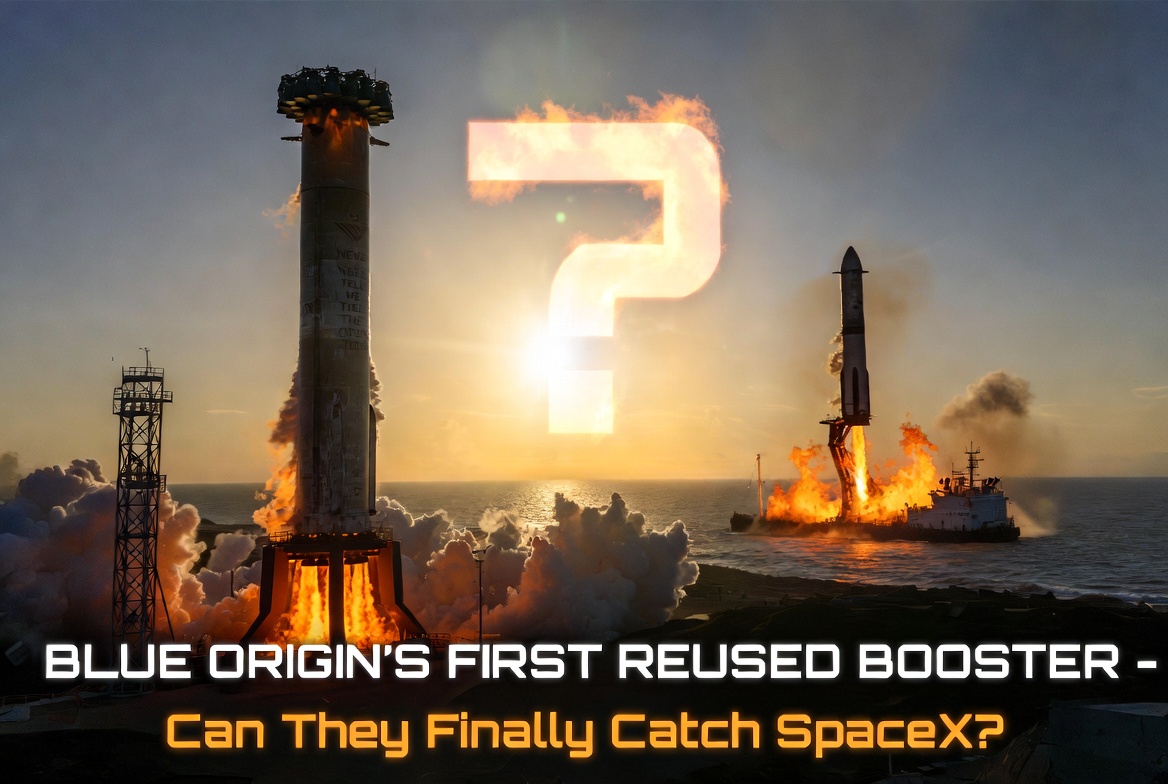
Every launch provider talks about reuse. Only a few have shown what operational reuse actually looks like over time. For Blue Origin, New Glenn’s first reflight attempt is important because it moves the company out of the landing-proof phase and into the harder question: what happens after recovery.
That is the real threshold. Bringing a booster back is impressive. Reflying one in a way that supports dependable launch economics is something else entirely. Blue Origin’s next step is therefore meaningful not because it immediately changes the market, but because it begins to test the company’s full reusability model under real conditions.
The mission also arrives in a market that no longer rewards vague promises. Customers now know what mature reuse looks like. Any competitor entering that arena will be judged against that standard.
Blue Origin is trying to fly a previously used New Glenn booster again. That matters because the future of reusable rockets is not just about landing them once. It is about proving they can be refurbished, reflown, and eventually operated often enough to lower costs and increase launch cadence.
SpaceX changed the definition of success
Any discussion of launch reuse now begins with SpaceX because the company made the extraordinary look normal. Falcon 9 did not just show that boosters could survive flight, landing, and refurbishment. It showed that repeated booster use could become routine enough to reshape the economics and tempo of launch.
That changed the benchmark for everyone else. A competitor does not catch up merely by landing once or reflighting once. It has to prove turnaround discipline, hardware durability, mission reliability, and a credible path to volume. Reuse is no longer a public-relations milestone. It is an operations problem.
That is why Blue Origin’s effort deserves both respect and scrutiny. The company is entering a phase where the comparison stops being conceptual and becomes practical.
The real question is not whether Blue Origin can reuse a booster once. It is whether New Glenn can become a system where reuse is normal enough to matter commercially.ISN Editorial Board
What Blue Origin still has to prove
New Glenn has obvious strengths as a vehicle. It is large, ambitious, and designed from the beginning with reuse in mind. But the key word there is designed. Design intent is not operational proof.
The central challenge is not whether the booster can physically survive a second flight. It is whether the refurbishment path becomes efficient enough to support meaningful cadence. A reusable rocket that requires extensive intervention, slow turnaround, or major component replacement each cycle may still be technically impressive while remaining commercially constrained.
That is the tension in this moment. Blue Origin is making visible progress. It is also still early enough in the lifecycle that each reuse event carries outsized informational value.
Why a conservative first reflight is not a weakness
There is a temptation to read any engine replacement, thermal protection update, or careful refurbishment cycle as evidence that Blue Origin is far behind. That conclusion may be too simplistic. Early reusability programs are supposed to be conservative. They are supposed to expose margins, identify wear patterns, and build confidence in the refurbishment logic before attempting faster operations.
In that sense, a cautious first reflight is not a failure of ambition. It is a recognition that large launch systems earn operational credibility through iteration, not declaration. Blue Origin does not need to match the most mature reuse model immediately. It needs to show that each flight meaningfully reduces uncertainty.
The important thing is whether the trajectory bends toward shorter turnaround and lower-touch reuse over time.
Why this is still a high-stakes moment
Even so, the stakes are real. Launch customers have alternatives. If New Glenn cannot move from successful demonstrations to dependable reuse, its value proposition narrows. A heavy-lift rocket without strong operational reuse can still win missions, but it will have a harder time defining the market.
Blue Origin also does not operate in a static competitive environment. SpaceX continues to set the pace in routine reuse, while its next-generation ambitions evolve in parallel. That means Blue is not just racing to establish its own system. It is doing so while the reference point keeps moving.
That is why this reflight matters more than a normal incremental upgrade. It is one of the first moments where Blue Origin can begin to demonstrate whether New Glenn’s reusability architecture translates into a durable competitive position.
What success would actually look like
A successful reflight would be important, but it would not be sufficient by itself. The stronger signal would be what follows. Does the booster return again? Does the refurbishment path tighten? Do turnaround windows become easier to forecast? Do customers begin to see New Glenn as a reusable workhorse rather than an occasionally reused heavy launcher?
Those are the metrics that matter because they connect engineering to market reality. The industry does not need another impressive one-off. It needs evidence that a second major player can turn reuse into an ordinary part of launch operations.
If Blue Origin gets there, the impact could be substantial. More pricing pressure, more launch availability, and a stronger two-provider environment would all matter for civil, commercial, and national-security customers.
What failure would mean
A setback would not end the program, and it would not prove reuse was the wrong strategy. But it would reinforce an important truth the industry already knows: real operational reuse is extremely difficult, especially at heavy-lift scale. There is a difference between building a rocket that can be reused and building a launch business that thrives because reuse works.
That distinction is what this moment is really about. Blue Origin has the resources, patience, and hardware ambition to stay in the race. What it now needs is evidence that New Glenn can move from capability to habit.
If that happens, this mission may later be remembered as an early turning point. If it does not, it will be remembered as a reminder that catching up in launch reusability requires more than a landing. It requires a system.