
Artemis II has already done what NASA needed it to do: put a crew around the Moon again and remind the public that deep-space exploration is no longer just a historical memory. In that context, a programmable NASA-themed smartwatch could have been easy merchandising. Instead, the better way to read it is as a small but useful educational product released into an unusually receptive moment.
The watch arrives when Artemis is once again part of everyday conversation. That matters. Educational hardware tends to work best when it is attached to a live story, not a museum story. A student learning how a sensor, display, or wireless connection behaves is more likely to care when that experience is tied to an active era of lunar exploration.
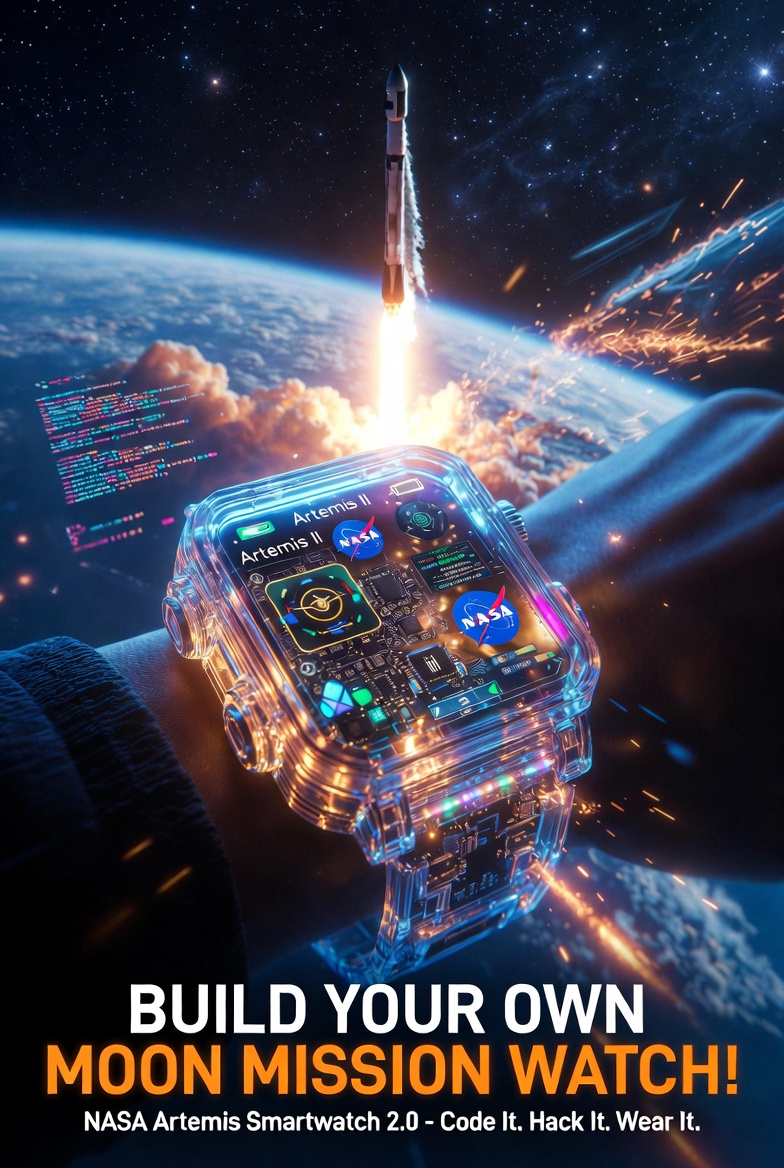
The Artemis Watch 2.0 is not just a NASA-branded accessory. It is a programmable smartwatch designed to teach how connected devices work, using a space theme to make coding, sensors, and embedded hardware feel more immediate.
What the watch actually is
The strongest thing about the Artemis Watch 2.0 is that it does not ask users to choose between fun and functionality. It works as a real smartwatch, but it is also built to be programmed. That combination is important because many educational devices succeed at one and fail at the other.
CircuitMess positions the watch as a ready-to-use, programmable wearable with Bluetooth connectivity and activity-tracking features. It includes the kinds of hardware that make a device worth exploring rather than just wearing: a display, motion-related sensors, orientation sensing, and temperature sensing. In practical terms, that gives learners something more interesting than a static microcontroller board. It gives them a device that already behaves like a modern product.
That distinction matters because students do not just need abstract lessons. They need systems they can recognize.
The real value of a device like this is not that it looks space-age. It is that it lets beginners move from using technology to understanding how technology is assembled, programmed, and extended.ISN Editorial Board
Why the programming side is the real story
The watch’s most credible feature is not its branding. It is the programming stack. CircuitMess supports beginners through a block-based environment, then allows progression into Python and Arduino-based workflows for users who want more control. That is the right ladder.
Too many STEM products are either so simplified that they become disposable, or so technical that they lose first-time users immediately. The Artemis Watch 2.0 appears to aim for the middle ground. A beginner can start by changing behaviors and displays in a guided way. A more advanced user can move into custom watch faces, simple applications, experiments with sensor data, and broader embedded-device logic.
That is what turns a novelty into a platform. Even at a small scale, it introduces the mindset behind real engineering: observe the hardware, inspect the software, change the behavior, test the result.
Why wearable hardware is a smart teaching format
A smartwatch is a more effective teaching object than it may seem. It is compact, sensor-rich, battery-powered, and visibly personal. That makes it a good vehicle for learning because cause and effect feel immediate. If the screen changes, if motion data appears, if a custom app responds to a gesture, the result is right there on the wrist.
For a young builder, that immediacy matters more than technical purity. A board on a desk can teach electronics. A wearable can teach ownership. The Artemis Watch 2.0 makes coding feel less like homework and more like configuration of a real product.
That is a powerful bridge, especially for users who are more likely to stay engaged when a device looks finished enough to matter.
Where the product is strongest, and where it is not
The value proposition here is educational, not premium-consumer. That is important to say clearly. This is not trying to compete with mainstream health-focused smartwatches on polish, biometric depth, or sleekness. It is built around programmability, visibility into hardware, and beginner-friendly experimentation.
That means the right buyer is not someone shopping for a refined everyday wearable first. The right buyer is a student, hobbyist, parent, teacher, or space enthusiast who wants a hands-on device with a lower barrier to entry than a full custom electronics project.
In that sense, the limitations are part of the product definition. The watch is not trying to disappear into daily life. It is trying to invite interaction.
Why the NASA connection works
Space branding can feel superficial when it stops at logos. Here, the Artemis connection works because it aligns with the product’s actual purpose. Artemis is not just about destinations. It is also about systems engineering, iteration, autonomy, communications, and human-machine interfaces. A programmable watch does not replicate those mission systems, but it points in the same educational direction.
That is why the pairing with rover-themed kits also makes sense. It encourages a broader understanding of exploration hardware as an ecosystem rather than a single object. Communications, sensing, interfaces, remote control, and user feedback all start to connect.
For Independent Space News readers, that is the more interesting angle. The product is not valuable because it puts Artemis on a wrist. It is valuable because it makes technical literacy feel adjacent to a living exploration program.
What products like this may actually be building
The long-term case for educational hardware is rarely about the device itself. It is about the habit it creates. A programmable watch is a small object, but it can normalize a very important idea: technology is not sealed. It can be inspected, modified, and understood.
That matters for space, because future lunar and Mars infrastructure will be built by people comfortable with systems, constraints, debugging, telemetry, and hardware-software interaction. Not every student who touches a device like this becomes an engineer. But products like this widen the path between curiosity and competence.
That is the real reason the Artemis Watch 2.0 deserves attention. It is not mission hardware. It is pre-mission mindset hardware.