
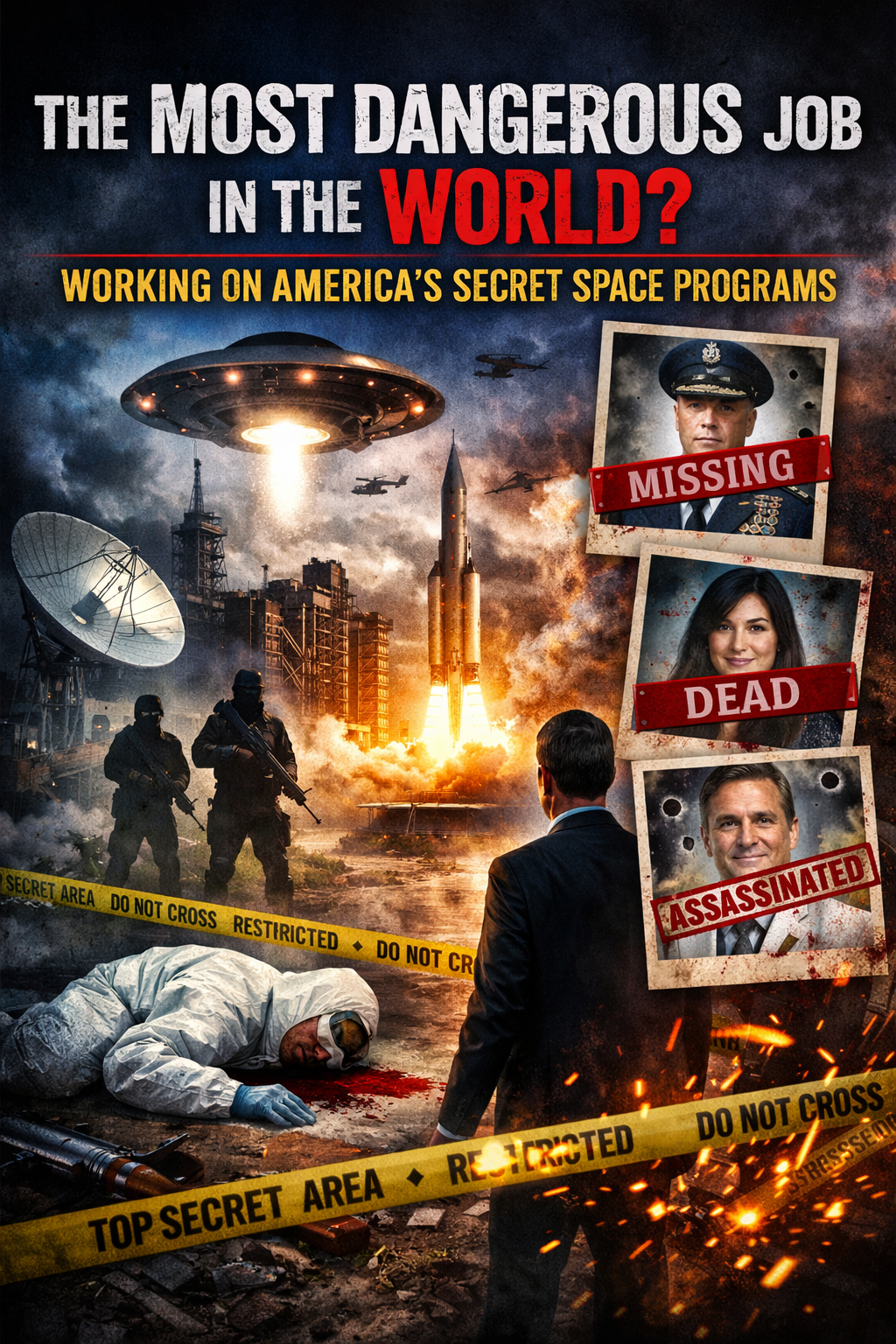
Stories involving scientists, classified work, and unexplained deaths or disappearances have a way of accelerating quickly. Part of that is cultural. Secret programs invite suspicion even when evidence is thin. Part of it is structural. The people involved often work in fields where the public already assumes that sensitive knowledge, national-security stakes, and institutional secrecy overlap.
That is why the current wave of attention matters. Once multiple cases involving aerospace researchers, former military officials, and defense-adjacent personnel begin appearing in the same public conversation, the issue stops feeling isolated. It starts to look like a pattern, whether or not investigators ultimately conclude there is one.
That is the difficult balance here. Public concern is understandable. Public certainty is not.
A number of missing-person and death cases involving people tied to aerospace, defense, or advanced research are now being discussed together. That does not prove a coordinated cause, but it does raise legitimate questions about how such a specialized community can become the focus of so much concern so quickly.
What makes these cases different from ordinary headlines
The reason these cases draw unusual attention is not simply that the individuals were accomplished. It is that many were linked, directly or indirectly, to work that the public associates with strategic advantage: propulsion, aerospace systems, classified defense programs, advanced materials, or sensitive research institutions.
In those environments, expertise itself is often treated as a national asset. That creates a different emotional reaction when something goes wrong. A disappearance involving a retired general with space-program ties or a scientist working in a specialized laboratory does not land in the public imagination as a local tragedy alone. It lands as a possible security question.
That does not mean foul play is established. It means the public threshold for concern is lower when the people involved are embedded in high-consequence work.
The danger in cases like these is not only the possibility of a hidden connection. It is also the speed with which a lack of explanation gets filled by certainty, because secrecy and expertise make almost any coincidence feel loaded.ISN Editorial Board
Why caution matters as much as concern
There is a strong temptation to collapse very different cases into one narrative. Missing-person investigations, confirmed homicides, unexplained deaths, mental-health crises, accidents, and unresolved circumstances do not all belong to the same category just because the individuals worked in adjacent fields.
That distinction matters. If the public conversation treats every case as proof of a coordinated attack, it risks outrunning evidence and distorting both journalism and investigation. But if officials treat public concern as irrational by default, they risk deepening mistrust around institutions that already operate behind layers of secrecy.
The responsible position sits in the middle: concern without overclaim, scrutiny without manufactured certainty.
Why the aerospace and space community is sensitive to this
The aerospace world is not large in the way the broader public imagines. At the highest technical levels, it is a relatively tight ecosystem of laboratories, contractors, agencies, university researchers, retired officers, and specialized engineers whose work overlaps through programs, institutions, and professional networks.
That makes any cluster of high-profile cases feel closer than raw numbers alone would suggest. It does not take many incidents for a niche professional community to feel exposed. When the work already involves classified access, export controls, foreign-intelligence risk, and strategic competition, the background anxiety is already there. A string of alarming cases simply gives it a focal point.
That is why the story hits the space and defense world especially hard. It touches an existing fear: that frontier work is not only intellectually demanding, but personally vulnerable.
What investigators are really being asked to answer
The public question is often framed dramatically: are experts working on advanced projects being targeted? But the investigative task is more precise. Are these cases connected at all? If so, by what mechanism? Professional overlap? Institutional overlap? Geography? Foreign intelligence? Public rumor? Or no overlap beyond coincidence amplified by visibility?
That is a difficult standard to meet in public, especially when some of the people involved have backgrounds touching classified programs. Even if investigators find no coordinated threat, that conclusion may not satisfy audiences primed to expect something darker. If they do find concerning links, the public explanation may still be partial because of the sensitivity of the work involved.
This is one reason the story has such staying power. It sits at the point where public curiosity meets the limits of what institutions can or will explain clearly.
What this says about the modern security climate
Even without a single definitive explanation, the story reveals something important about the present moment. The United States is operating in an era of sharper competition over aerospace, semiconductor, nuclear, cyber, and space capabilities. In that environment, people with specialized knowledge are seen not only as employees or researchers, but as carriers of strategic value.
That does not automatically turn every tragedy into a covert operation. It does mean the broader context is one of heightened suspicion, sharper institutional defensiveness, and greater public willingness to see targeted intent where official explanations remain incomplete.
For the space sector, that wider atmosphere matters. The more space becomes central to communications, intelligence, missile warning, and economic infrastructure, the harder it becomes to separate “space story” from “security story.”
The most important question is still unresolved
The hardest question is not whether these cases are disturbing. They are. The hardest question is whether the public and the government can tolerate uncertainty long enough for facts to lead. In stories involving secrecy, advanced technology, and high-profile disappearances, uncertainty rarely stays empty for long.
That is why the coming official updates matter. They may not provide closure. They may not confirm a dramatic hidden plot. But they will help determine whether this becomes a short-lived panic, a legitimate counterintelligence concern, or a lingering open wound in public trust.
For now, the most responsible conclusion is also the most unsatisfying one: the pattern is serious enough to warrant scrutiny, but not yet clear enough to support the strongest claims being made about it.