
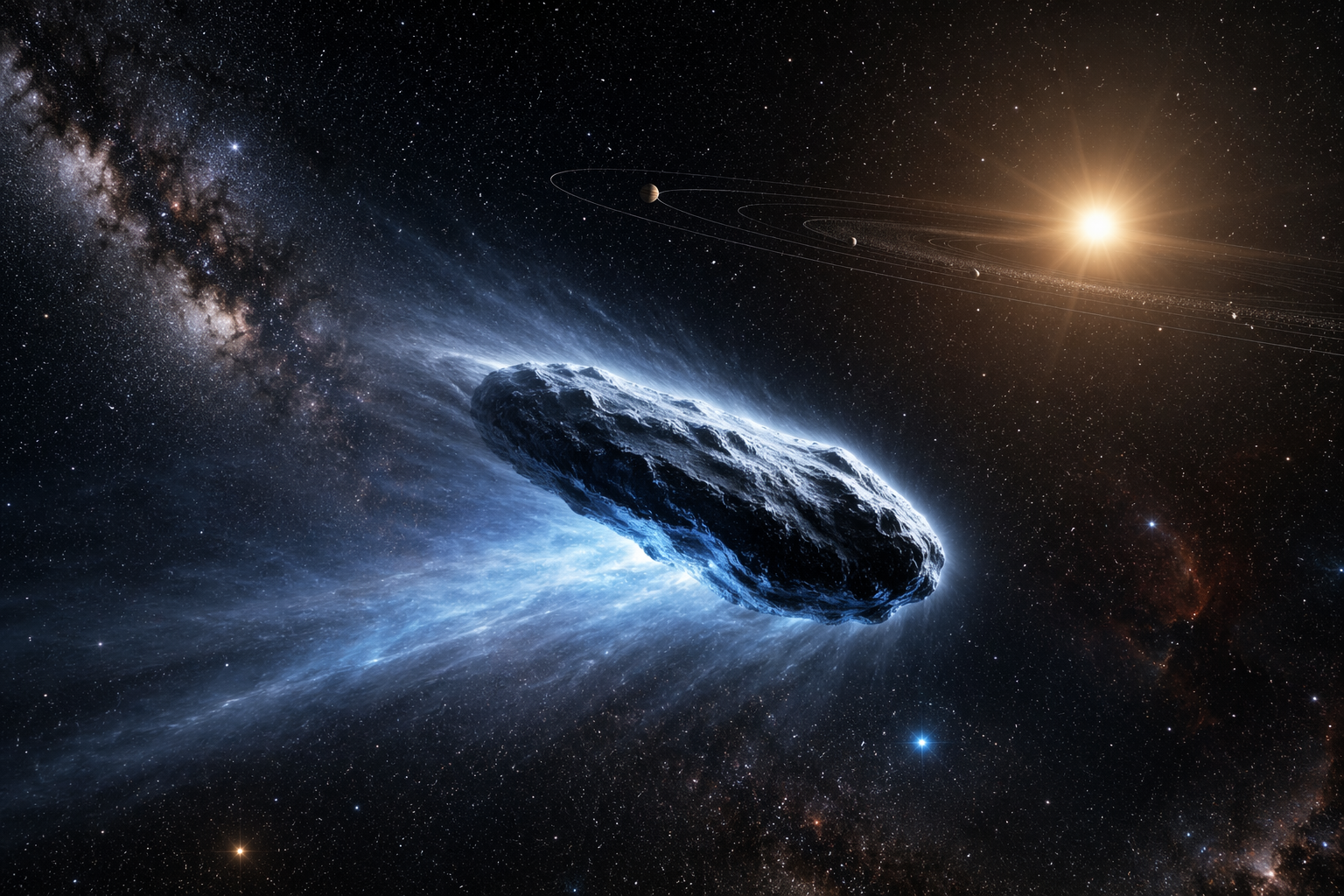
Something ancient just crossed our cosmic neighborhood, and it may be one of the clearest chemical clues yet to how other worlds begin.
Astronomers using the Atacama Large Millimeter/submillimeter Array, or ALMA, have measured the water chemistry of the interstellar comet 3I/ATLAS and found something extraordinary: its isotopic signature looks nothing like the cometary water ratios we are used to in our own Solar System.
That matters because comets are more than icy wanderers. They are chemical archives. Their ices preserve information about the environments in which they formed, often for billions of years. In the case of 3I/ATLAS, that archive appears to have come from a much colder and chemically different origin than the one that produced the Sun, the planets, and the familiar comet families of our own system.
3I/ATLAS is carrying a very unusual water chemistry signature that points to formation in a far colder environment than our own Solar System. That makes it a rare sample of another planetary system’s birth conditions.
A different kind of water
The heart of the discovery is not just water itself, but a specific version of it: deuterated water, also called semi-heavy water or HDO. In this form of water, one of the hydrogen atoms is replaced by deuterium, a heavier isotope of hydrogen.
That substitution turns out to be extremely useful. The ratio of ordinary water to deuterated water acts like a record of formation conditions. In our Solar System, cometary water contains only a small fraction of this semi-heavy form. But in 3I/ATLAS, ALMA measurements found a deuterium enrichment in water that is more than 30 times higher than typical Solar System comet values and more than 40 times higher than Earth’s oceans.
That is not a subtle variation. It is a fundamentally different chemical fingerprint.
The object is not just an odd visitor. It is an archive from a very different cosmic nursery.ISN Editorial Board
What that fingerprint means
Researchers say such an elevated deuterium signature points to formation in extremely cold conditions — environments colder than about 30 Kelvin, just tens of degrees above absolute zero. Those are the kinds of conditions expected either in a prestellar molecular cloud before a star fully forms, or in the very outermost regions of a young planetary disk where temperatures stay brutally low and chemistry proceeds differently.
In simple terms, 3I/ATLAS was likely assembled in a place far colder, less irradiated, and less thermally processed than the environment that gave rise to our own Solar System’s comet reservoir.
That is why this object feels less like an odd visitor and more like a message from a very different cosmic nursery.
Possibly far older than our Solar System
The chemistry is only part of the story. The object’s estimated kinematic age is between 3 and 11 billion years, according to the new Nature Astronomy study. If the upper end of that range proves right, 3I/ATLAS could be more than twice as old as our Solar System.
That possibility changes the scale of what we are looking at. This would not just be material from another planetary system. It could be material from a system that formed when the Milky Way itself was much younger.
That is why “time capsule” is not just a metaphor here. Interstellar objects like 3I/ATLAS are among the only natural samples we can study directly that originated around other stars and then wandered into our own system carrying their birth chemistry with them.
A chemically rich visitor
The water result also fits with another major clue astronomers found earlier this year: 3I/ATLAS is chemically rich in methanol. ALMA observations published in March found unusually high methanol relative to other cometary molecules, offering further evidence that this object formed under conditions distinct from those typical of our local comet population.
Methanol is not life. But it is part of the broader inventory of organic chemistry that makes comets so important to origin-of-life discussions. In our own Solar System, comets are often studied as potential delivery vehicles for water and organic compounds in the early histories of planets. Seeing similar ingredients in an object from another system does not prove life is common, but it does strengthen the case that prebiotic chemistry may arise across a much broader range of cosmic environments than once assumed.
Why 3I/ATLAS feels different
We have only confirmed a tiny number of interstellar visitors so far. Each one has changed the conversation. But 3I/ATLAS is different because it is not merely dynamically unusual — it is chemically diagnostic.
Its deuterium-rich water gives astronomers something rare: a direct probe of the physical conditions under which another planetary system formed. Not a simulation. Not an analogy. Not an exoplanet atmosphere seen from far away. A real object, carrying real molecules, passing through our Solar System long enough for us to measure them.
That is a remarkable kind of access.
The bigger implication
The most exciting implication is not just that 3I/ATLAS is exotic. It is that the basic ingredients of chemically interesting worlds may emerge under a wider range of conditions than we used to imagine.
That widens the map.
It suggests that complex chemistry is not confined to Sun-like conditions or the familiar thermal history of our own system. Even in regions that are colder, darker, and more isolated, the universe is still building molecules that matter: water, organics, and chemically rich ices that can later be transported, heated, or incorporated into planets and smaller bodies.
In that sense, 3I/ATLAS is not just telling us where it came from. It is telling us something about the diversity of planetary origins across the galaxy.
A new era of interstellar chemistry
For decades, the study of planetary origins has relied mostly on our own backyard: planets, moons, asteroids, and comets that formed around the Sun. Interstellar objects change that framework. They let us sample, however briefly, the chemistry of other systems without ever leaving home.
And 3I/ATLAS may be the strongest example yet of what that future could look like.
It reminds us that the galaxy is not just filled with stars and planets. It is filled with frozen records of environments we have never visited. Some of them may be old. Some of them may be chemically strange. Some may look, in key ways, surprisingly familiar.
The recipe changes. The conditions vary. But the underlying process continues.
Water. Organics. Cold chemistry. Planet-building ingredients.
That is what makes 3I/ATLAS so compelling. It is not simply an object from somewhere else. It is evidence that the universe has many ways of assembling the raw materials that matter — and that sometimes, if we are lucky, one of those ancient archives drifts into view long enough for us to read it.