
The next phase of lunar activity will not be defined only by who lands, or even by who stays longest. It will be defined by who can sustain operations. On the Moon, that quickly becomes a power problem.
Habitats, communications systems, scientific payloads, mobility platforms, thermal control, and resource-processing equipment all depend on reliable electricity. The more ambitious the mission becomes, the less power can be treated as a secondary subsystem. It becomes core infrastructure.
That is especially true at the lunar south pole, where much of the current strategic focus is concentrated. The region is attractive because of its potential access to water ice and long-duration operational value. But it also creates unique solar constraints that conventional flat-panel thinking does not handle especially well.
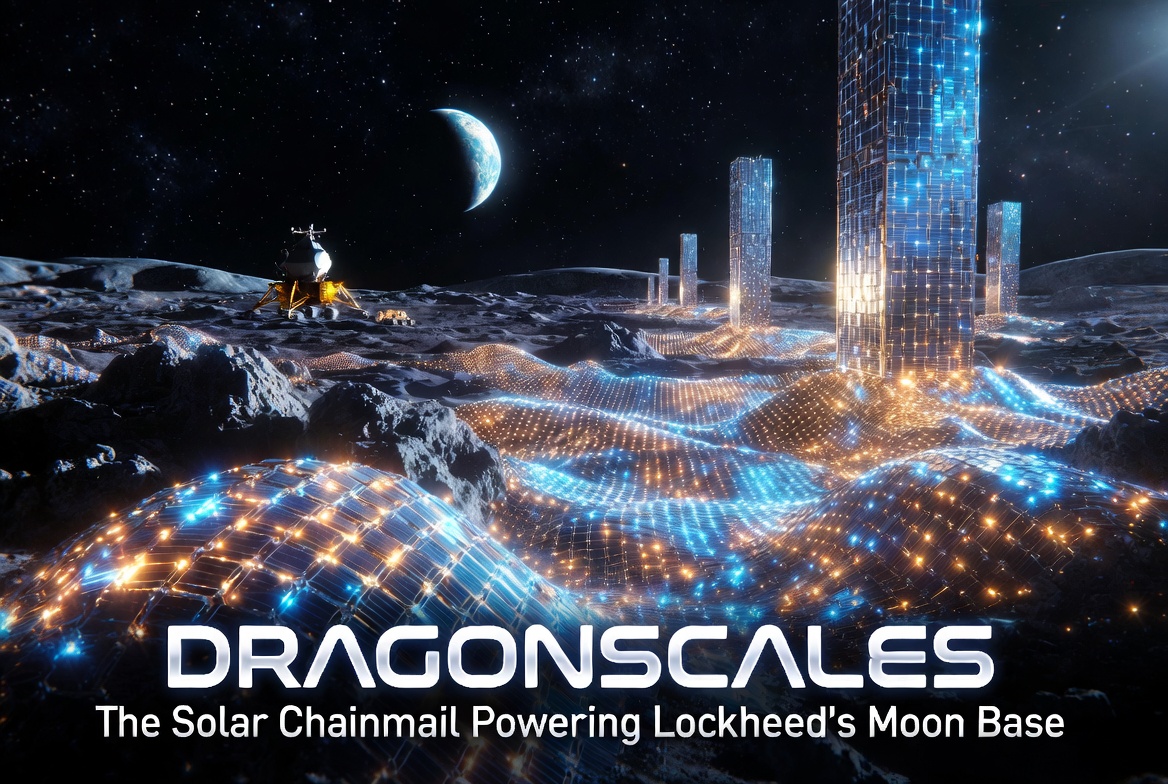
DragonSCALES are flexible solar meshes designed to be lighter and easier to deploy than traditional rigid panels. That makes them especially interesting for lunar missions, where transport mass, difficult terrain, dust, and unusual sunlight angles all make conventional solar systems harder to use.
What DragonSCALES actually change
DragonSCALES matter because they challenge the default assumption that space solar systems must look like scaled-down versions of terrestrial rigid panels. Instead, the technology is built as a flexible mesh of many small interconnected silicon cells, creating a surface that can bend, conform, and be packaged more efficiently.
The engineering logic here is straightforward. If a power system is lighter, easier to transport, and less dependent on rigid geometry, it becomes much more adaptable to off-world use. That adaptability is not cosmetic. It affects launch mass, deployment complexity, storage volume, and survivability.
For lunar use, that combination is unusually valuable. The Moon is not just remote. It is logistically expensive. Any power system that reduces fragility and transport burden starts with an advantage.
The most important thing about DragonSCALES is not that they look futuristic. It is that they treat power generation as deployable infrastructure rather than delicate hardware that must arrive in one rigid, unforgiving form.ISN Editorial Board
Why the south pole changes the solar equation
The lunar south pole is often described as a promising location for sustained operations, but that promise comes with a complication: sunlight behaves differently there than it does in the simpler solar-power models many people imagine. At high lunar latitudes, the Sun can remain low on the horizon for extended periods, which changes how effectively flat horizontal panels can collect energy.
That is why vertical or near-vertical solar architectures have become so interesting. A flexible solar material that can be integrated into upright deployment systems is not just a novel form factor. It is a response to a specific operational environment.
In that context, Lockheed’s interest in vertical solar arrays built around DragonSCALES makes strategic sense. The point is not simply to use lighter panels. It is to use a solar system geometry that better matches the Moon’s lighting conditions.
Why flexible solar is about deployment as much as efficiency
Space systems are rarely constrained by only one variable. Even if DragonSCALES offered no efficiency benefit at all, flexibility alone would still matter because deployment is one of the hardest parts of surface infrastructure. Rigid panels require careful packaging, careful handling, and a higher degree of structural protection. They are not ideal for rough surfaces, dust exposure, or rapid autonomous setup.
A lighter and more conformal solar structure changes the deployment problem. It becomes easier to imagine systems that can be transported compactly, unfold with fewer failure points, and adapt to terrain rather than demand perfect geometry from it.
That makes the technology relevant not just for fixed sites, but also for temporary infrastructure, distributed assets, and future mobile or semi-mobile surface systems.
Why Lockheed would see this as more than a niche component
Large aerospace contractors do not usually invest attention in a technology unless they see a system-level consequence. In this case, the consequence is obvious. If flexible solar architectures work reliably on the Moon, they could reduce cost, mass, and operational complexity across multiple mission classes.
That reaches beyond one base concept. A successful power architecture at the south pole could influence cargo landers, long-lived science stations, communications nodes, rover support systems, and future industrial operations tied to resource extraction or processing.
In other words, DragonSCALES are not interesting because they are unusual. They are interesting because power is foundational, and foundational technologies scale outward into everything else.
The real test is durability, not promise
As with many lunar technologies, the concept is easy to like before it is forced to survive the environment. The Moon is harsh in ways that do not always show up cleanly in presentation materials. Dust is abrasive and persistent. Thermal cycling is extreme. Radiation exposure is nontrivial. Mechanical simplicity, long-duration reliability, and repairability all matter more once a system is off Earth.
That means the question for DragonSCALES is not whether the architecture is elegant. It is whether the system can preserve performance under repeated exposure to actual lunar conditions. That includes packaging stress, deployment stress, dust accumulation, surface degradation, and long-term output stability.
If those tests go well, the technology becomes much more than an interesting materials story. It becomes serious lunar infrastructure.
Why this matters for a permanent lunar economy
The phrase “lunar economy” can sound abstract until it is reduced to infrastructure requirements. Permanent or semi-permanent activity on the Moon will need transport, communications, resource handling, shelter, and power. Of those, power is the layer that quietly governs all the others.
That is why a technology like DragonSCALES deserves attention. It sits at the level where small engineering improvements can unlock broader architectural changes. A better power system does not just improve energy collection. It can change where missions are viable, how long systems can remain active, and how much deployment labor future crews or robotic systems must absorb.
If the Moon is to become a place of repeated work rather than repeated visits, power systems will need to become lighter, tougher, and easier to deploy. DragonSCALES fit that requirement well enough to be worth watching closely.