
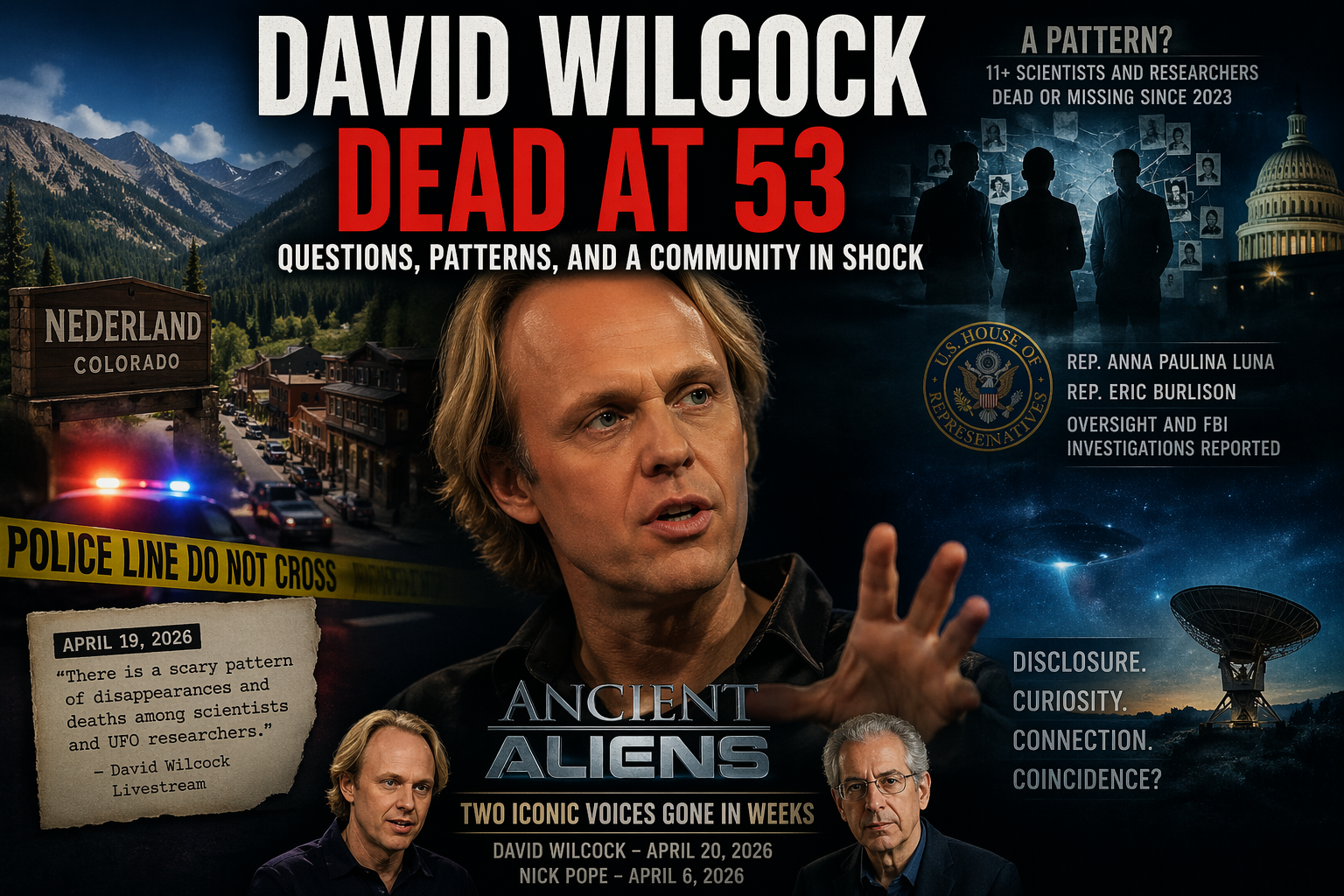
The death of David Wilcock on April 20, 2026, is tragic on its own terms. It has also become something else almost immediately: a cultural flashpoint inside the broader world of UFO belief, disclosure politics, and public fascination with the unknown.
The verified facts are stark and should come first. Boulder County officials said deputies responded to a 911 call near Ridge Road in unincorporated Boulder County, Colorado, where the caller appeared to be experiencing a mental health crisis. According to the sheriff’s office, deputies encountered a man outside a residence holding a weapon, and within minutes he used the weapon on himself. He was pronounced dead at the scene. The coroner later identified the decedent as 53-year-old David Wilcock. On April 23, Boulder County released an additional public timeline and, with the family’s consent, a statement saying Wilcock “took his own life” after what they described as a long struggle with depression and overwhelming financial debt.
That is the confirmed reality. And it matters to state it plainly, because nearly everything else being said around this story is being layered on top of those facts.
Wilcock occupied a specific place in modern space-adjacent culture. He was not an astronaut, scientist, or government investigator. But he became one of the most recognizable public figures linking ancient civilizations, extraterrestrial speculation, consciousness claims, and modern disclosure narratives. Through books, livestreams, conferences, and television appearances, he helped shape a media ecosystem in which ideas once dismissed as fringe could be repackaged as part of a much larger cosmic story.
The facts of David Wilcock’s death are a personal tragedy. The bigger story is how quickly the UFO and disclosure world turned that tragedy into a test of belief, suspicion, and cultural identity.
Why the reaction has been so intense
That is why his death is resonating beyond the usual circles of personal grief. It lands at a moment when the culture around unidentified anomalous phenomena is unusually unstable — no longer fully fringe, but not fully accepted either.
For years, that ambiguity sustained a self-contained subculture. But over the last several years, official institutions have changed the tone. The Department of Defense established the All-domain Anomaly Resolution Office, or AARO, in 2022, and in 2023 launched a public-facing website with reporting trends, official materials, photos, videos, and records related to unresolved or declassified UAP cases. NASA, for its part, commissioned an independent UAP study in 2022, held a public meeting in 2023, and released a final report along with a new director of UAP research.
None of that validates Wilcock’s worldview. But it does help explain why figures like him suddenly feel closer to the center of public conversation than they did a decade ago. The institutions are not endorsing the mythology. They are, however, acknowledging that unidentified phenomena deserve some level of organized public inquiry.
The same ecosystem that encourages curiosity and skepticism can also make it hard to separate confirmed fact from story-making under stress.ISN Editorial Board
What changed in the public weather
That shift is crucial. It changes the emotional weather around stories like this. Once governments, defense agencies, and NASA begin using the language of transparency, public records, and scientific study, communities that spent years talking about UFOs on the margins often interpret every major event through that lens. Personal tragedy, cultural mythology, and institutional suspicion start to blur together.
That appears to be exactly what is happening here.
There has already been widespread online discussion trying to connect Wilcock’s death to larger patterns, hidden pressures, or disclosure-related narratives. At this point, there is no verified public evidence supporting those claims. The problem is not that people are asking questions. The problem is that a culture trained to read significance everywhere can begin to treat coincidence, timing, and mood as evidence before the evidence actually exists.
That is why this moment matters beyond one personality or one tragic event. It shows how quickly the modern UAP conversation can become emotionally and symbolically overloaded. The same ecosystem that encourages curiosity, pattern recognition, and skepticism toward institutions can also make it difficult to distinguish between confirmed fact, plausible inference, and story-making under stress.
Why this belongs in a space publication
In that sense, Wilcock’s death has become a mirror for the larger state of UFO culture in 2026.
People are not just responding to the death of a media figure. They are responding to years of built-up expectations around disclosure, hidden truths, and the belief that the official and unofficial worlds are finally beginning to converge. That convergence is real in one narrow sense: AARO exists, NASA has published its UAP study, and the language of “unidentified anomalous phenomena” is now part of mainstream policy and science discussion. But that does not mean the jump from public inquiry to cosmic confirmation has actually happened. Many people still live emotionally inside that gap.
That helps explain why the reaction has been so intense.
Wilcock also represented a particular kind of crossover figure. He belonged to the entertainment-and-interpretation side of space culture rather than the engineering or scientific side, yet he drew energy from the same deep human questions that animate both: Are we alone? Is history stranger than we think? What is being hidden from us? What happens when official institutions begin to sound, even faintly, like they are reopening questions once treated as absurd?
The collision is only getting stronger
Those questions are not going away. If anything, they are becoming more culturally potent as public and private space activity accelerates, artificial intelligence amplifies pattern-seeking and rumor cycles, and more people encounter the language of UAP through official channels rather than just television specials and YouTube feeds.
That is why this story belongs, in part, in a space publication. Not because it proves anything about alien life, and not because tragedy should be repurposed into mythology, but because it reveals how space culture now works. The boundary between aerospace policy, scientific ambiguity, internet folklore, and mass entertainment is getting thinner. The stories that sit in that overlap shape how millions of people interpret the unknown.
The responsible approach is therefore twofold. First, stay anchored to verified facts. Second, take seriously the cultural meaning of why so many people want those facts to imply something larger.
What the moment does and does not say
That does not mean indulging every theory. It means recognizing that we are living through a period when curiosity about space, disclosure, intelligence, science, and the unknown is no longer neatly sorted into separate boxes. That overlap can produce insight. It can also produce distortion.
David Wilcock’s death does not settle any larger question about UFOs, disclosure, or hidden programs. What it does reveal is how emotionally charged those questions have become — and how quickly they can absorb personal tragedy into broader narratives about cosmic significance.
As the UAP era becomes more public, more bureaucratic, and more mainstream, that tension will only grow. The challenge for journalists, researchers, institutions, and audiences is not merely to keep asking questions. It is to keep asking them without losing the distinction between what is confirmed, what is suggested, and what is simply feared or hoped for.