
The Challenger disaster remains one of the defining tragedies in American spaceflight. It is remembered for the seven astronauts lost, for the national grief that followed, and for the way it reshaped NASA’s culture and public standing. But within that larger history, certain smaller artifacts endure because they make the loss feel personal rather than abstract.
The Clear Lake High School soccer ball is one of those artifacts. It was not mission hardware. It was not a scientific payload. It was a personal item, signed by students and carried by astronaut Ellison Onizuka as a link between his work in space and the community around him.
That is why the story survives. The ball turned a national tragedy into something local, human, and deeply tangible.
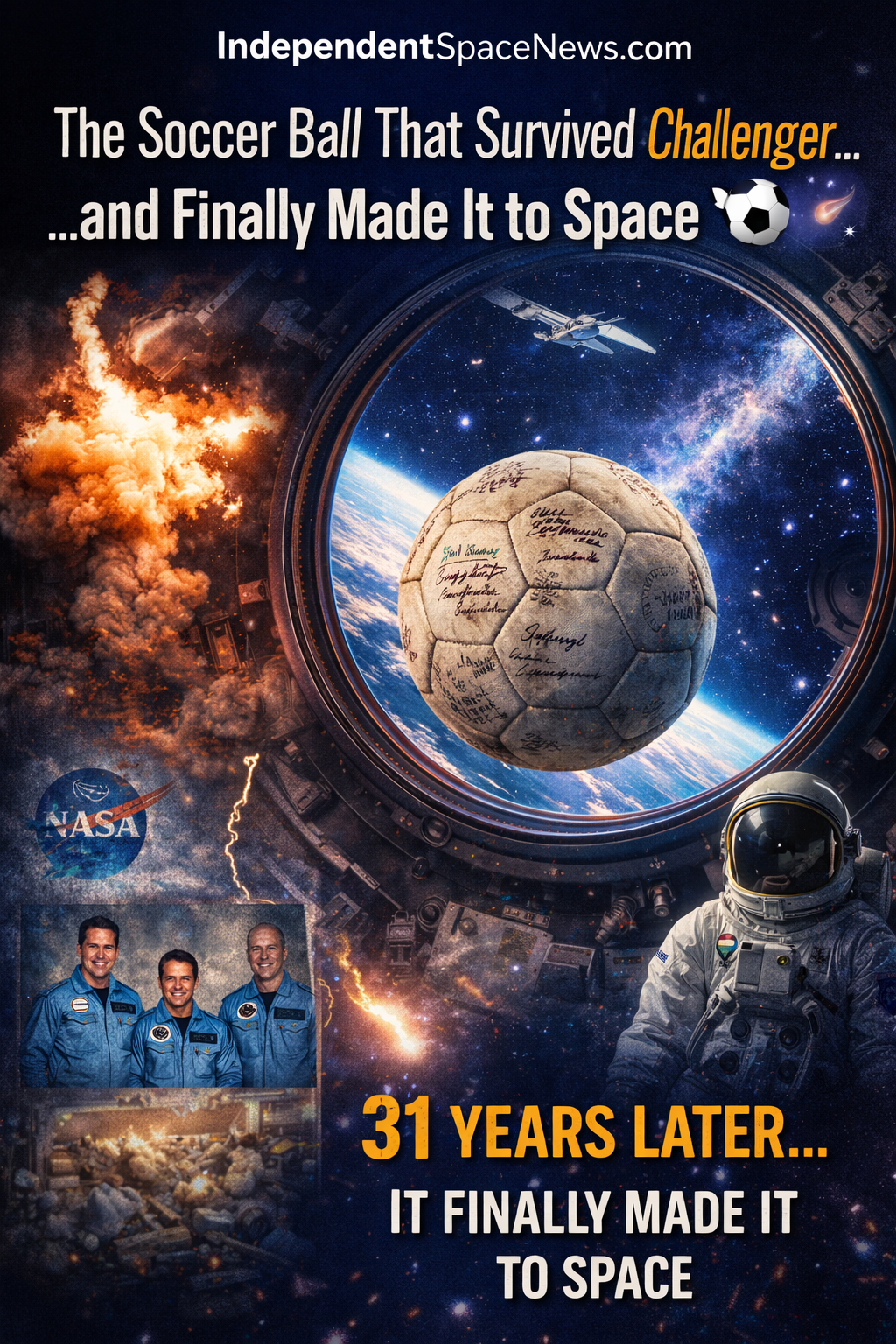
A signed soccer ball carried on Challenger in 1986 was recovered after the accident, preserved for decades at Clear Lake High School, and finally flown to the International Space Station by astronaut Shane Kimbrough in 2016. It became a symbol of resilience and unfinished memory rather than just a recovered object.
The first journey ended in catastrophe
Onizuka brought the ball aboard Challenger as part of his personal preference kit. The inscription and signatures connected it directly to Clear Lake High School, the community near NASA’s Johnson Space Center where his daughter and her teammates had signed it. It was, in the simplest sense, a good-luck token.
Then Challenger was lost 73 seconds after launch on Jan. 28, 1986. For most people, that would seem like the end of the story. Yet the ball did not vanish with the mission. Search and recovery efforts eventually found Onizuka’s personal effects, including the ball, and it was returned to his family.
That recovery is what gives the story its unusual power. The object endured when so much else had been destroyed. It became not just a reminder of what was lost, but a physical survivor of the event itself.
The reason this story resonates is not that a soccer ball reached orbit. It is that an object touched by one of NASA’s darkest days was later allowed to complete the journey it never got to finish.ISN Editorial Board
Why the school became part of the mission’s long afterlife
After the accident, the ball eventually made its way back to Clear Lake High School, where it remained on display for decades. That mattered because it anchored the story in a living community rather than leaving it frozen in archival memory. Students who had no direct connection to Challenger still encountered the ball as a reminder that the people in NASA history books had once moved through the same neighborhoods, schools, and ordinary places.
In that sense, the ball did more than commemorate Onizuka. It preserved a relationship between a local school and a national space story. It made the tragedy feel inherited, not distant.
That is also what made its eventual return to space so emotionally coherent. The object had never stopped belonging to a community that still cared what happened to it.
The second journey changed the meaning of the artifact
In 2016, NASA astronaut Shane Kimbrough carried the ball to the International Space Station during Expedition 49/50. The decision was not arbitrary. Kimbrough had ties to Clear Lake High School through his son, and the school’s principal helped revive the story of the artifact and its unfinished mission.
Once aboard the station, the ball finally did what it had been meant to do decades earlier: float in orbit as a small piece of home carried by an astronaut into space. Kimbrough later photographed it in the station’s Cupola, turning the object into a visible bridge between the Challenger era and the present-day ISS era.
That is what transformed the story from recovery into completion. The artifact was no longer only a survivor. It had become a second-chance payload.
Why this was bigger than nostalgia
It would be easy to treat this as a sentimental postscript to a famous tragedy. But the stronger reading is about continuity in human spaceflight. NASA is an institution built not only on technology, but on memory. Missions are connected across decades by rituals, symbols, losses, and acts of remembrance that help later generations inherit earlier ones with care.
The soccer ball illustrates that perfectly. It linked Challenger to the International Space Station, one era of NASA to another, and one astronaut’s personal gesture to a later astronaut’s act of stewardship. The story reminds us that spaceflight history is not composed only of breakthroughs and disasters. It is also made of efforts to carry meaning forward.
That is why this object feels so much larger than its size. It represents a promise kept long after the original mission was gone.
What this says about the role of personal objects in spaceflight
Personal artifacts often matter more than their material value suggests. Flags, photographs, school patches, rings, notebooks, and small mementos have long traveled with astronauts because they connect extraordinary missions to ordinary life. They remind both crews and the public that exploration is never only technical. It is social, emotional, and communal.
The Challenger soccer ball belongs to that tradition, but with unusual force. It is not simply a keepsake that flew. It is a keepsake that survived disaster, waited through decades of memory, and then completed the arc it began.
That makes it one of the rare artifacts in space history whose symbolism grew larger over time rather than fading with distance.
Why the story still feels current
In an era of commercial launches, renewed lunar ambitions, and increasingly routine orbital operations, stories like this provide something that technical progress alone cannot. They remind us that the human meaning of spaceflight accumulates across generations. A school can remember. A family can preserve. An astronaut can carry the memory onward.
The soccer ball did not just survive Challenger. It survived the risk that history becomes too clean, too institutional, or too abstract. By finally reaching orbit, it restored something unfinished and gave a community a visible form of closure without erasing the tragedy that made closure necessary.
That is why the story endures. The ball did not only return to space. It carried remembrance there and brought it back whole.