
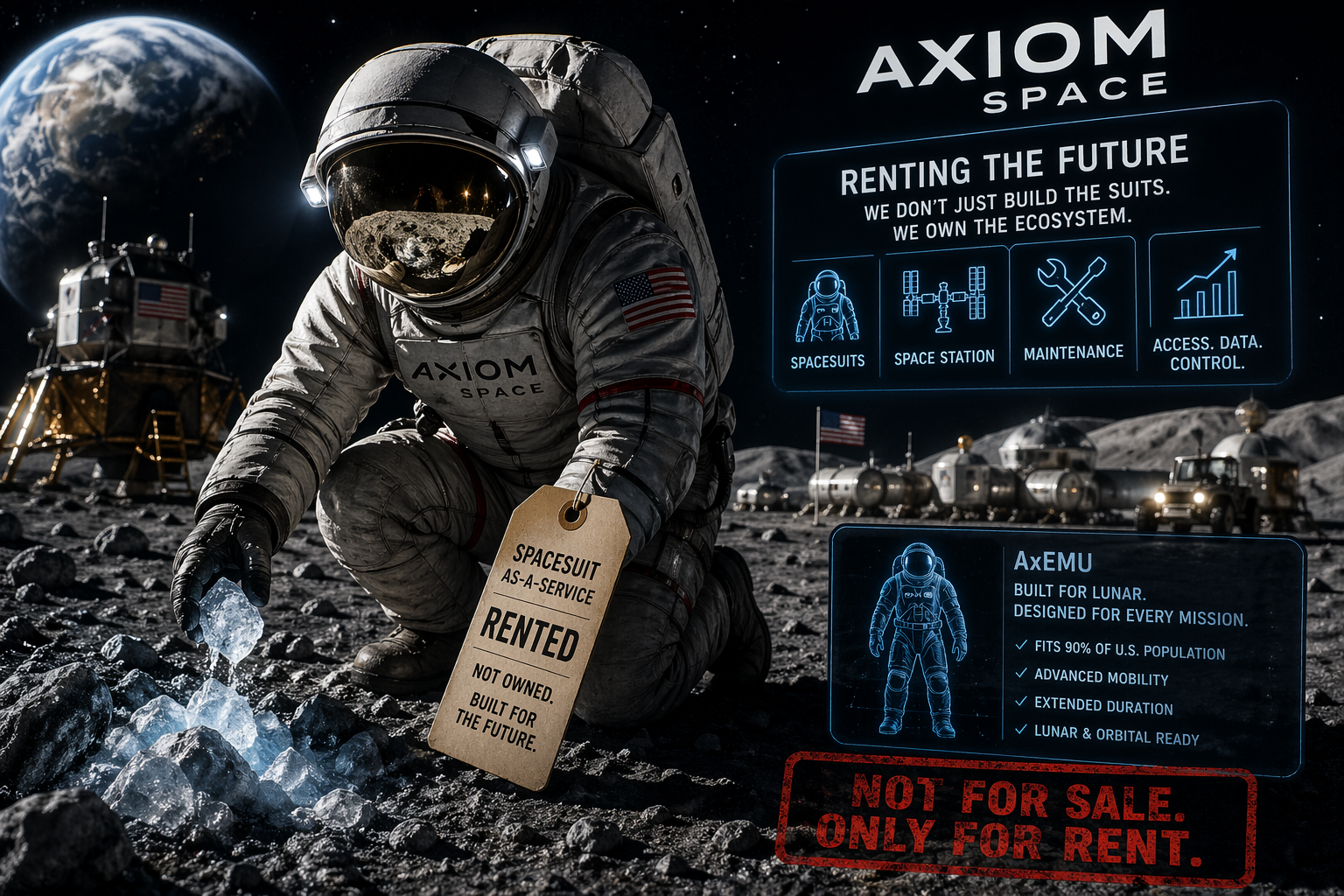
Picture an astronaut on the lunar south pole, crouched at the edge of a shadowed crater, brushing ancient ice into a sample tube. The suit they are wearing may be one of the most important pieces of infrastructure in the Artemis era — and one of the least discussed. It is not just a suit. It is a service contract, a supply chain, a maintenance burden, a training pipeline, and potentially a commercial moat.
That is why Axiom Space’s delayed AxEMU matters so much.
The obvious story is schedule slippage. NASA’s lunar timeline has moved. Artemis III, once imagined as the first crewed return to the Moon, is now scheduled for mid-2027 as an Earth-orbit mission focused on integrated testing and rendezvous operations, while Artemis IV is now the mission NASA says will return humans to the lunar surface in early 2028. That change alone buys Axiom more time — but it also raises a larger question: is the company merely late, or is it quietly building the operating system for who gets to work off-world at all?
The suit itself is real, and so is the progress. In February 2026, NASA said Axiom’s lunar suit had passed a contractor-led technical review. The agency also said Axiom had begun receiving parts for the first flight unit, with assembly set to begin later in the spring. NASA further noted that the system is designed to fit a broad range of crew members, accommodating at least 90 percent of the U.S. male and female population while improving mobility for the kinds of surface work Apollo suits were never asked to support.
Axiom’s lunar suit is late relative to earlier Artemis expectations, but the delay may be giving the company time to turn spacesuits into a recurring service business. NASA is buying a capability, not simply a one-off piece of hardware, and that changes who may control EVA access in the future.
When delay starts to look like leverage
That is not trivial. NASA’s existing ISS suits are decades old, and the agency’s own inspector general says they carry serious constraints and safety concerns for the future exploration roadmap. The OIG’s April 2026 review also underscored how fragile the current provider landscape has become. In 2024, NASA and Collins Aerospace agreed to remove Collins’ task orders, leaving Axiom as the only active spacesuit provider under the agency’s next-generation commercial program.
That concentration matters. When one supplier becomes the only realistic path to both lunar and low-Earth-orbit EVA services, schedule risk becomes market power.
The AxEMU is already being sold as more than a single-mission artifact. NASA’s own language around the Extravehicular Activity and Human Surface Mobility Program emphasizes commercial partnerships and a services model rather than the old government-owned suit-fleet mindset. The agency has said this approach is meant to let vendors innovate, mature their systems, and eventually offer those capabilities outside NASA programs. In other words, the structure of the deal is the point. Axiom is not just building a Moon suit. It is building a reusable business position.
Spacesuit-as-a-service stops sounding like procurement jargon and starts sounding like strategy once one company can influence who gets to step outside at all.ISN Editorial Board
The real prize is the operating layer
Once a private company controls development, support, upgrades, and future availability of advanced EVA systems, it is no longer merely a contractor delivering hardware into a government warehouse. It becomes a gatekeeper to operational capability. If Axiom succeeds, the same company helping NASA reach the lunar south pole could eventually supply orbital EVA systems to commercial stations, private crews, researchers, sovereign customers, and future lunar operators.
That possibility looks even bigger when viewed next to Axiom Station. In February 2026, Axiom announced $350 million in new financing, saying the funds would help accelerate both its station work and its spacesuit development. NASA has already approved a revised assembly sequence for the station in which the Payload Power Thermal Module launches first, attaches to the ISS, and later detaches to become the first free-flying element of Axiom’s commercial outpost. The company is not just trying to sell missions. It is trying to own tools, habitat, access, and eventually the commercial operating environment around all of them.
Seen from that angle, the delays look different.
Why the delays may still serve the strategy
Yes, they are real. NASA’s inspector general warned that spacesuit development could slip much further if recent historical delay patterns continue. The report describes an acquisition strategy that has produced optimistic schedules and left NASA with only one active provider at a moment when Artemis surface operations still depend on multiple pieces of unproven hardware coming together. But Axiom’s position is not purely defensive. Every month of additional runway gives the company more time to refine a suit that can serve not just a ceremonial first landing, but an entire commercial era in cislunar space and low-Earth orbit.
That is why the headline question is bigger than “Will the suit be ready?” The more important question may be: what exactly is Axiom trying to own?
The answer appears to be leverage at the layer where human beings physically interact with space. Not rockets. Not capsules. Not just stations. The suit itself — the literal interface between a human body and an off-world workplace.
A commercial moat around EVA
The Prada partnership helped turn the AxEMU into a cultural object, but the real significance is industrial. NASA says the suit builds on earlier xEMU work, uses a high-mobility upper torso, and is intended to support longer-duration exploration at the lunar south pole. That means more than better photos. It means more capable fieldwork, more flexible crew sizing, and more room for the kind of iterative service model private industry prefers over one-off government ownership.
And that leads to the uncomfortable part.
If one company ends up controlling the most mature EVA systems for both the Moon and commercial orbit, then access, pricing, maintenance priorities, and upgrade cadence could all begin to flow through a private platform logic. NASA may gain flexibility from buying services. But in the long run, it may also be helping create a market structure in which future customers rent capability from whoever owns the suit stack.
That does not make Axiom wrong. In fact, it may be exactly how the post-ISS space economy matures. But it does mean the public conversation should move past launch dates and into market structure. The next decade will not be defined only by who lands first. It will be shaped by who owns the infrastructure that lets people stay, work, repair, sample, and survive once they get there.
The bigger question
Axiom’s gamble is that the biggest money in human spaceflight will not come from selling a single mission. It will come from becoming indispensable to many of them.
So yes, the lunar suit is late by the standards once advertised. But that delay may be hiding the deeper reality: Axiom is not simply trying to deliver a spacesuit to NASA. It is trying to become the commercial landlord of human EVA.
And if that is true, then the most important question is not whether the AxEMU launches on the original timetable. It is whether the future it helps build will feel open, competitive, and expandable — or gated by whichever company controls the tools required to step outside.