
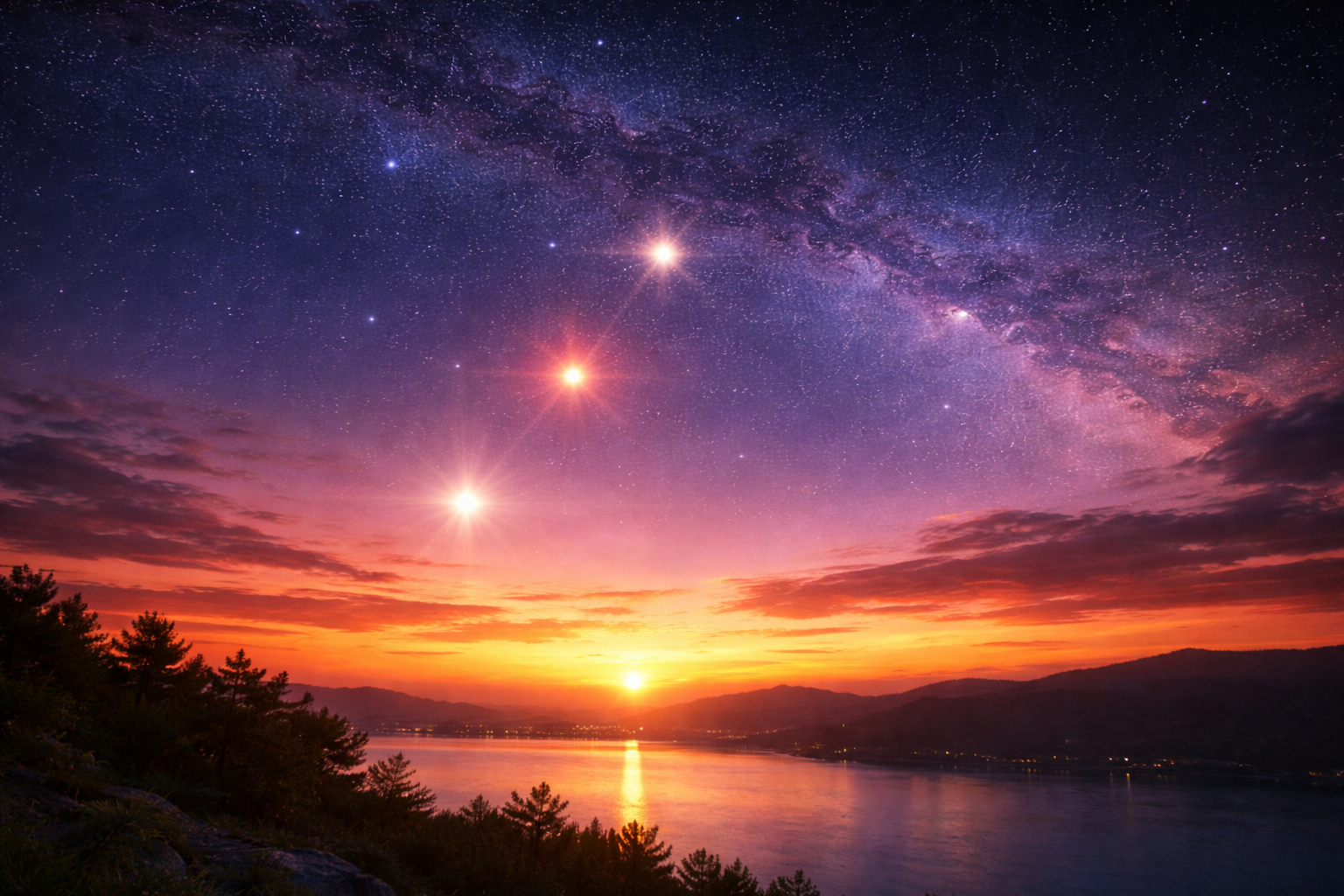
The morning sky is offering a compact planetary grouping this week, and it is one of those events that rewards planning more than perfection. Mercury, Mars, and Saturn are drawing unusually close together low in the east before sunrise, with Neptune nearby for observers using optical aid. The arrangement is fleeting, low to the horizon, and easy to miss if you wait too long.
During the second half of April 2026, Mercury, Mars, and Saturn appear crowded into a very small patch of the predawn sky. They are close enough that, from many locations, the grouping changes shape noticeably from one morning to the next. Around the same stretch of sky, Neptune is also present, though much fainter and generally out of reach without binoculars or a telescope.
That is what makes this event appealing. It is not a formal “lineup” in the strictest sense, nor is it a single one-night-only show. It is a compact, shifting grouping that rewards repeated viewing. On some mornings the planets form an obvious triangle. On others they stretch into a diagonal arrangement. The geometry is part of the fun.
The challenge is that the whole scene sits very low above the eastern horizon and is quickly swallowed by dawn.
Mercury, Mars, and Saturn are clustered low in the east before sunrise this week, and Neptune is nearby for people using optical aid. The best way to see them is from a location with a clear eastern horizon about 30 to 45 minutes before sunrise, before the growing daylight washes them out.
Why this is easy to miss even though it is real
Events like this often sound bigger than they look in practice because “planet parade” can suggest a dramatic, high-altitude display. This one is more subtle and more demanding. The planets are there, but they are hugging the horizon in brightening twilight, especially for viewers in northern latitudes.
That means timing matters. Look too early and the planets may still be too low. Look too late and the sky brightens fast enough to erase the dimmer members of the group. The viewing window is short, which is one reason these gatherings feel more special than a normal evening-planet sighting.
It is also why a clear eastern horizon matters more than expensive gear. Trees, buildings, haze, or local terrain can make the difference between a memorable sight and no sight at all.
The best celestial events are not always the brightest ones. Sometimes the most memorable views come from knowing exactly when to look, where to stand, and how quickly the sky is about to change.ISN Editorial Board
Which mornings are strongest
The grouping is especially compact from roughly April 16 through April 21, with April 18 through April 20 standing out as particularly strong mornings for many observers. Around that period, the three brighter planets appear within only a few degrees of one another and shift between triangular and diagonal arrangements.
That does not mean the event disappears outside those dates. It means those mornings are the most concentrated phase of the display. After that, the planets begin to spread apart and the visual neatness of the gathering starts to soften.
In practical terms, that means there are only a handful of mornings where the view feels especially compact and photogenic.
What you are actually looking for
Mercury is usually the easiest anchor in the group because it is the brightest of the three in this configuration. Saturn is dimmer and steadier, while Mars appears fainter and warmer in color. Neptune is there too, but for most observers it is not part of the naked-eye experience.
If the sky is clear and your horizon is open, the visual reward comes from seeing multiple planets share such a small region of sky. This is the kind of event that compresses the scale of the solar system into something that feels briefly manageable. Distant worlds, moving on their own orbital schedules, happen to align from our perspective for a few mornings and then drift apart again.
That changing perspective is what skywatching does best. It makes motion visible.
Why the Southern Hemisphere has an advantage
This event is generally friendlier to the Southern Hemisphere because the ecliptic, the path the planets follow across the sky, meets the horizon at a steeper angle before dawn there during this season. In practical terms, the planets climb a bit higher above the horizon and remain visible longer before sunrise overwhelms them.
Northern Hemisphere observers can still catch the grouping, but the challenge is greater. The planets remain low, the twilight window is shorter, and atmospheric haze near the horizon becomes more of a problem. That does not make the event poor from the north. It simply means expectations should be calibrated.
A successful northern view may feel more like a precise catch than a leisurely session.
How to make the most of it
The best strategy is simple. Find an unobstructed eastern horizon, go out about 30 to 45 minutes before local sunrise, and let your eyes adjust for a few minutes. If you have binoculars, bring them, but use them carefully and only while the sun is still fully below the horizon. Neptune in particular is more a binocular or telescope target than a naked-eye one.
This is not a heavy-equipment event. It is a planning event. A thermos, a clear horizon, and one good morning are more useful than elaborate gear used from a blocked suburban street.
And because the arrangement changes each day, there is real value in trying more than once if the weather cooperates.
Why gatherings like this matter
Planetary groupings are reminders that the sky is not static. Even familiar planets are always moving, and every now and then their motion produces a pattern visible enough to pull ordinary observers outside before dawn. That is one reason these events resonate so strongly. They are accessible, but not routine.
This particular gathering is also a useful corrective to the screen-bound way many people now experience astronomy. No observatory, livestream, or simulation replaces the feeling of looking east and recognizing three planets sharing a small patch of sky before the sun erases the scene.
The event is brief, low, and a little demanding. That is part of its value. It asks for attention, and then it rewards it.