
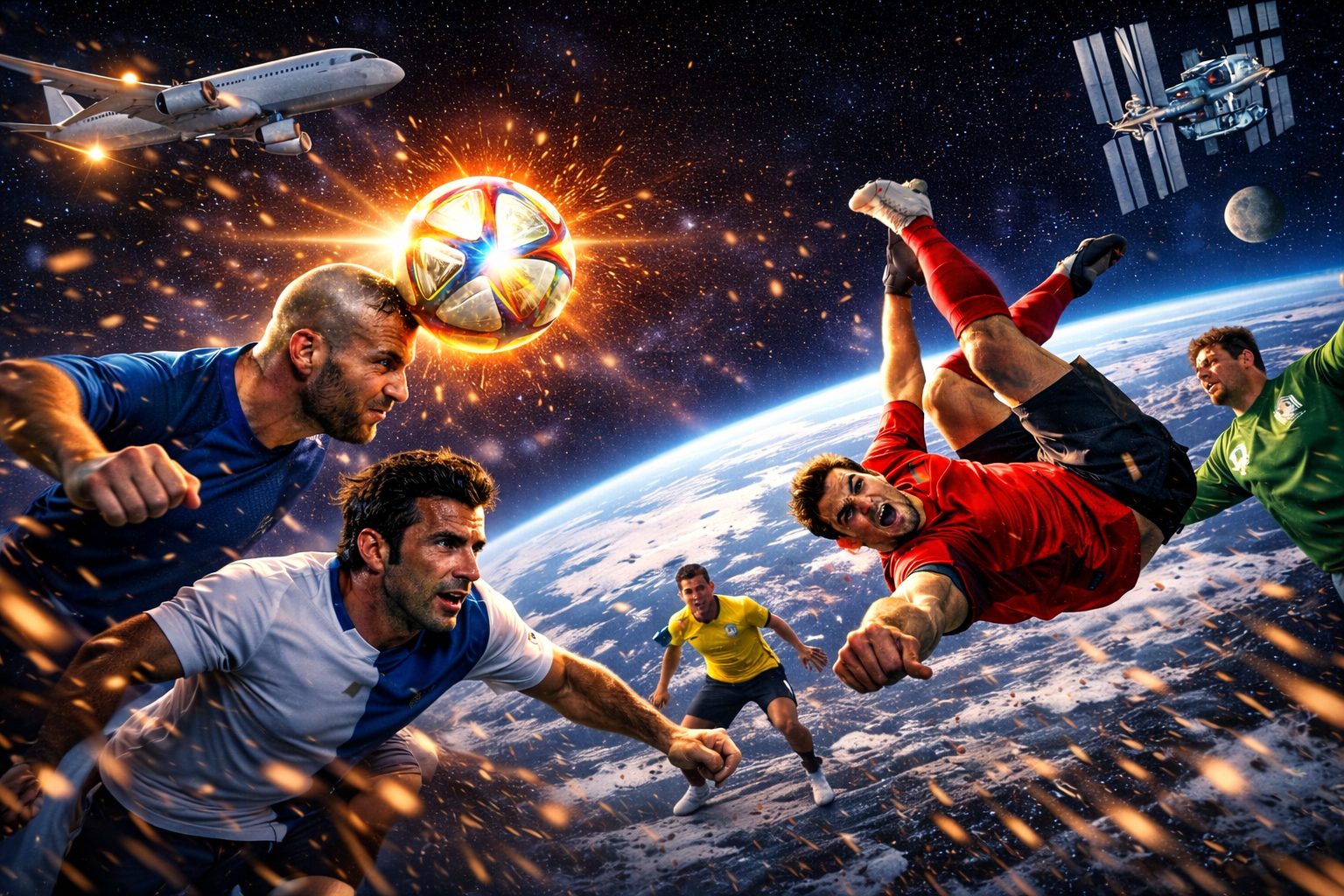
The best benchmark for football beyond the normal pitch is still the 2022 parabolic-flight match associated with Luís Figo, which set the Guinness World Record for the highest-altitude game of football on a parabolic flight. The event took place at 20,230 feet inside an aircraft configured to create short windows of microgravity.
That detail matters because the record was not just about altitude. It was about altered physics. During the microgravity phases, football stopped behaving like football in any ordinary sense. The ball floated, body control changed, and even simple passes became experiments in timing and orientation.
No one has meaningfully surpassed that benchmark yet. That is why it still matters. It remains the clearest demonstration that football can leave its natural environment and still remain recognizable as a sport rather than just a stunt.
Football has already been played in short bursts of microgravity at record altitude, and astronauts have improvised versions of the game in orbit. The open question now is whether the 2026 World Cup era inspires a more ambitious demonstration that pushes the sport even further beyond Earth-like conditions.
Why microgravity changes the game so quickly
On a normal pitch, players rely on an enormous amount of hidden certainty. Gravity pulls the ball down. Footing provides resistance. A pass has a predictable arc. A jump has a predictable landing. Remove or reduce those assumptions, and the sport changes immediately.
In parabolic flight, that change is dramatic but brief. A player cannot treat the body as a stable platform in the usual way. Touch must become more careful. Positioning becomes less about occupying a rectangle of ground and more about controlling drift and momentum inside a volume.
That does not make the game impossible. It makes the game newly physical in a different sense. Technique is still present, but it is filtered through unfamiliar constraints.
The interesting question is no longer whether football can be played in unusual gravity. It is whether the sport can evolve enough in those conditions to become a repeatable spectacle rather than a one-time demonstration.ISN Editorial Board
Orbit is not just higher altitude. It is a different sport geometry.
Football in orbit is a different proposition from football in parabolic flight. Astronauts aboard the International Space Station have occasionally used footballs in orbit as part of World Cup-related moments, and those clips offer a useful reminder that weightlessness does more than extend hang time. It changes the geometry of the game itself.
There is no single downfield direction in the conventional sense. There is no meaningful sideline unless one is imposed. A ball can drift in ways that feel slow and unnatural at first, while players can reposition by pushing off walls and surfaces rather than running in the usual way.
That makes “space football” less about preserving the old form exactly and more about discovering what remains essential when the field, the floor, and gravity are no longer dependable constants.
Reduced gravity may be more playable than zero gravity
If orbit suggests a fully reimagined version of the sport, reduced-gravity simulation suggests something subtler. Parabolic flight can also approximate lunar gravity, and that produces a more recognizable but still transformed version of play.
In reduced gravity, movement stretches. Jumps last longer. Recovery takes longer too. The ball still behaves more like a ball than it does in full microgravity, but timing changes enough to create a very different rhythm. The sport slows down in one sense and opens up in another.
That is why lunar-gravity football may ultimately be more relevant than zero-gravity football if the sport ever becomes a serious off-world demonstration. It preserves enough structure to remain legible while still revealing what another environment does to touch, pace, and control.
Why 2026 creates a real opening
The 2026 World Cup will be unprecedented in scale: more teams, more matches, and more distributed visibility across North America than any previous edition. Large tournaments often attract adjacent demonstrations, brand activations, and symbolic gestures meant to express the scale of the moment.
That is what makes the timing interesting. The technology for another altitude or microgravity football event already exists. Private launch companies are more visible than they were a decade ago. Parabolic flight is a known platform. The media logic for tying a high-profile off-world football demonstration to the largest World Cup ever is easy to understand.
None of that guarantees anything will happen. But it does make the next step feel plausible in a way it did not before. The gap between “novel football experiment” and “globally noticed World Cup-adjacent moment” is now much smaller.
This is about more than spectacle
It would be easy to dismiss all of this as marketing. Some of it inevitably is. But there is also a larger point. Sports reveal the rules of environments very quickly. Put football into reduced gravity or microgravity and you get a direct, intuitive demonstration of how movement, force, and coordination change beyond Earth.
That has cultural value. Space is often discussed through engineering, policy, and launch metrics. A sport like football translates physical change into something ordinary people can feel immediately. A drifting header or a floating volley tells a story about physics in a way a white paper cannot.
That is why the record still resonates. It is not just a novelty title. It is a small proof that one of Earth’s most universal games can survive contact with another environment and still make sense.
The next benchmark may not just be higher
The obvious next step is to break the altitude record. But the more interesting next benchmark may not be altitude alone. It may be duration, playability, or legitimacy. Can a version of football in altered gravity become coherent enough that people stop asking whether it is real football and start asking which team adapted better?
That is the threshold worth watching as the 2026 World Cup approaches. The tournament will not just celebrate where football is strongest on Earth. It may also invite a reminder that the sport has already started to move beyond Earth-like conditions.
The question is no longer whether football can leave the ground. It already has. The question is whether the next great football milestone will also be one of the sport’s first truly space-age ones.